Best 5 1990s Insert Sets Worth Collecting Today
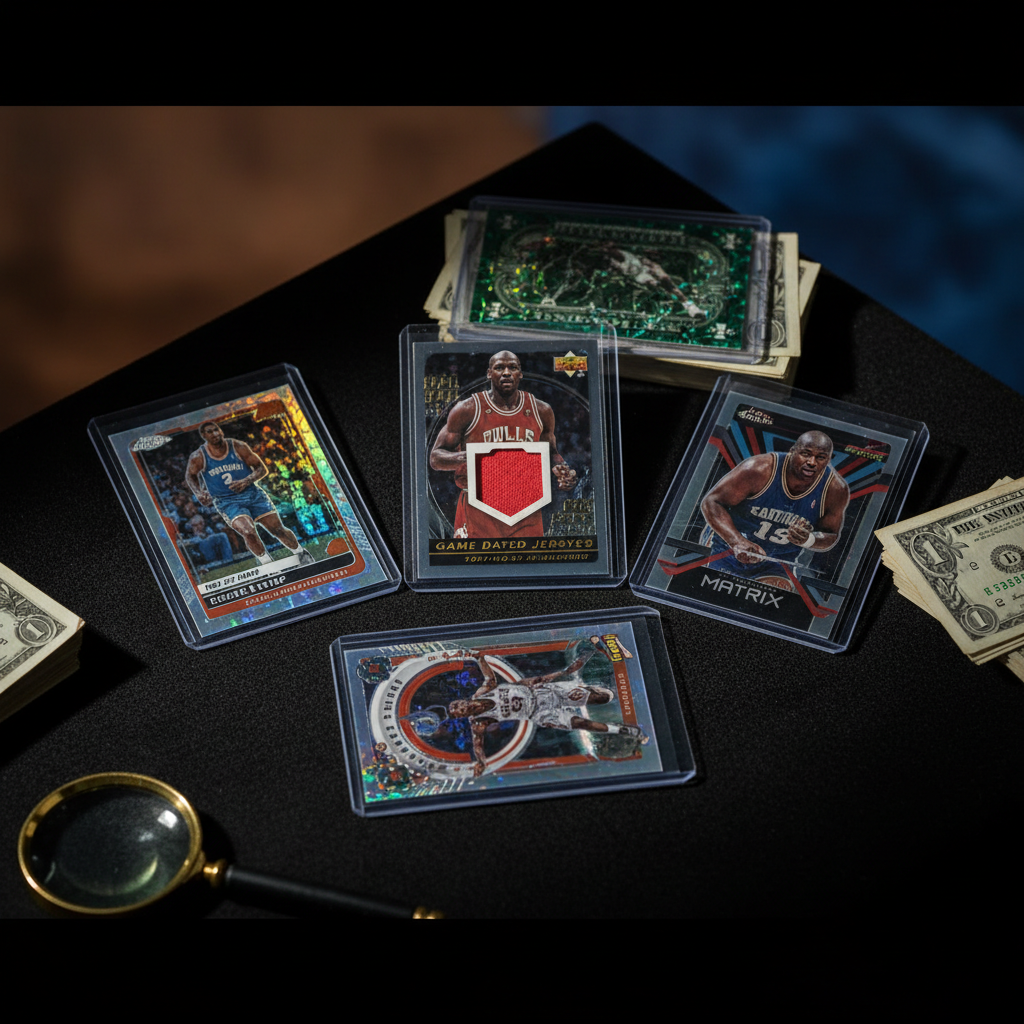
The 1990s insert market represents the apex of modern sports card design, where pack-odds scarcity, non-standard card stocks, and extreme condition sensitivity create an investable asset class fundamentally distinct from manufactured modern parallels. While modern ultra-modern products lean heavily on artificial color variations, the late 1990s pioneered true manufacturing innovation: multi-layered acetate, intricate die-cuts, brushed metals, and holographic embossing.
This guide evaluates the top five 1990s insert sets worthy of institutional allocation or serious collector acquisition today. To construct these selections, we filtered across three decades of secondary market performance, isolating sets that feature:
- Verifiable pack-odds scarcity (ranging from 1:240 to 1:1,140 packs).
- Sub-10% PSA 10 gem rates driven by brutal condition fragility.
- Blue-chip checklist depth featuring foundational icons such as Michael Jordan, Kobe Bryant, Ken Griffey Jr., and Shaquille O'Neal.
Whether allocating a $250 entry budget toward foundational mid-tier legends or committing $5,000+ to marquee condition-sensitive grails, these five sets offer unparalleled resilience against modern market dilution.
How We Picked
- Condition sensitivity & PSA 10 gem rate gem scarcity
- Pack insertion odds & stated print run rarity
- Innovation of card technology (acetate, die-cut, foil embossing)
- Sustained cross-generational liquidity and collector demand
- Risk-adjusted ROI profile over 5-year and 10-year horizons
At a Glance
| Rank | Pick | Best For | Price Range |
|---|---|---|---|
| 1 | 1997-98 Z-Force Big Men on Court (BMOC) Basketball | High-end basketball collectors seeking iconic, liquid grail inserts. | $175-$350 raw (mid-tier HOFs); $1,800-$5,000+ PSA 9/10 (superstars) |
| 2 | 1997 E-X2000 Essential Credentials (Now & Future) Baseball | Baseball collectors targeting elite cross-generational pop culture grails. | $200-$400 raw (common HOFs); $1,200-$3,500+ PSA 10 (Griffey/Jeter) |
| 3 | 1997-98 Metal Universe Planet Metal Basketball | Collectors who value structural card engineering and industrial design. | $150-$300 raw (tier-2 stars); $900-$2,800 PSA 10 (Jordan/Bryant) |
| 4 | 1998 Donruss Crusade (Green / Purple / Red) Baseball | Value-oriented investors looking for four-digit pack odds under $1,000. | $250-$500 raw (Frank Thomas/Ripken); $1,500-$4,200 PSA 10 (Griffey) |
| 5 | 1996-97 SkyBox Premium Golden Touch Basketball | Budget-conscious collectors entering high-end '90s basketball. | $80-$160 raw (Duncan/Iverson); $450-$1,200 PSA 10 (Jordan/Kobe) |
1. 1997-98 Z-Force Big Men on Court (BMOC) Basketball
The definitive peak of 1990s basketball die-cut design.
Inserted at a rate of 1:240 Series 1 packs, Big Men on Court represents the gold standard of 1990s basketball die-cuts. The dual-layer design—pairing a vivid electric background with an aggressive die-cut silhouette—leaves exposed, razor-thin borders that drop the PSA 10 gem rate below 8% across the entire checklist. With Jordan and Kobe anchoring the top end, even mid-tier Hall of Famers like Kevin Garnett and Tim Duncan maintain exceptionally liquid transaction velocity.
Best for: High-end basketball collectors seeking iconic, liquid grail inserts.
Price range: $175-$350 raw (mid-tier HOFs); $1,800-$5,000+ PSA 9/10 (superstars)
Pros
- Iconic multi-layered die-cut design with high display appeal
- Pack odds of 1:240 create genuine organic scarcity
- Deep checklist featuring prime Jordan, Bryant, Iverson, and Shaq
Cons
- Acetate is notoriously prone to surface clouding, fingerprints, and hairline scuffs.
- High capital barrier for top-tier names like Michael Jordan and Kobe Bryant.
2. 1997 E-X2000 Essential Credentials (Now & Future) Baseball
The pioneer of serial-numbered acetate that rewrote card manufacturing.
SkyBox's E-X2000 line revolutionized card engineering by fusing translucent plastic with micro-etched foil. Essential Credentials split into 'Now' and 'Future' tiers with staggered serial-numbering inversely matched to card numbers, limiting cards to print runs between 9 and 102 copies. Due to acetate chipping and perimeter foil separation, surviving high-grade copies command institutional premiums that outpace standard modern 1-of-1s.
Best for: Baseball collectors targeting elite cross-generational pop culture grails.
Price range: $200-$400 raw (common HOFs); $1,200-$3,500+ PSA 10 (Griffey/Jeter)
Pros
- Translucent acetate paired with vibrant holographic foil borders
- Extremely low serial print runs (tied to checklist placement)
- Unmatched aesthetic differentiation compared to traditional paper cards
Cons
- Susceptible to foil surface scratching that is difficult to spot in raw photos.
- Market prices fluctuate heavily with general Ken Griffey Jr. market sentiment.
3. 1997-98 Metal Universe Planet Metal Basketball
Industrial brushed metal married to raw 1990s scarcity.
Rather than simply using metallic foil, Fleer manufactured Planet Metal using an embossed, brushed-aluminum faceplate riveted onto traditional cardstock. The heavy metal surface made the card virtually impossible to pull centered or without micro-indentations, yielding one of the lowest gem rates of any late-90s insert set. Anchored by the peak 1997-98 Metal Universe release, this 15-card checklist provides bulletproof long-term liquidity across both basketball and pop-art collecting spheres.
Best for: Collectors who value structural card engineering and industrial design.
Price range: $150-$300 raw (tier-2 stars); $900-$2,800 PSA 10 (Jordan/Bryant)
Pros
- Real embossed brushed-aluminum metal faceplate technology
- Tough 1:240 pack odds in an already iconic standalone brand
- PSA 10 copies are exceptionally rare with sub-6% gem rates
Cons
- Cards are literally prone to oxidization and surface pitting if stored improperly.
- Brittle aluminum surface dents under minor package handling.
4. 1998 Donruss Crusade (Green / Purple / Red) Baseball
The blueprint for multi-tiered color parallel inserts.
Debuting in 1998 across multiple Donruss and Leaf products, Crusade established the multi-tier color hierarchy that modern products still copy today. While the unnumbered or high-run baseline versions are accessible, the Green (/250), Purple (/100), and Red (/25) tiers created an authentic chase with devastatingly low odds. The heavy card stock resists corner dings better than acetate, but surface centering and foil bubbles make Gem Mint copies coveted museum pieces.
Best for: Value-oriented investors looking for four-digit pack odds under $1,000.
Price range: $250-$500 raw (Frank Thomas/Ripken); $1,500-$4,200 PSA 10 (Griffey)
Pros
- Incredible staggered scarcity (Green /250, Purple /100, Red /25)
- Pioneered medieval chromium refractor aesthetics in baseball
- Broad checklist spanning premier '90s MLB legends
Cons
- Non-serial numbered, making total population estimation reliant on pack-out math.
- Heavily affected by UV fading if displayed unprotected.
5. 1996-97 SkyBox Premium Golden Touch Basketball
High-impact gold foil die-cuts at an accessible price point.
Distributed at 1:240 packs of 1996-97 SkyBox Premium Series 2, Golden Touch delivers the quintessential die-cut embossed aesthetic without requiring a five-figure bankroll. The card combines deeply recessed finger-print and basketball texturing with a high-gloss, gold-foil perimeter. Because the die-cut points are razor-sharp and the outer borders are black, factory chipping was endemic, making PSA 9 and 10 examples premium acquisitions for collectors seeking affordable 90s royalty.
Best for: Budget-conscious collectors entering high-end '90s basketball.
Price range: $80-$160 raw (Duncan/Iverson); $450-$1,200 PSA 10 (Jordan/Kobe)
Pros
- Striking embossed gold-die-cut holographic design
- 1:240 pack odds offer genuine chase mechanics under $500 raw
- Covers iconic 1996 draft class including rookie-era Kobe Bryant
Cons
- Slightly higher raw population than serial-numbered counterparts.
- Prone to edge chipping along the dark outer borders.
How to Buy
Where to Source Safely
High-end '90s inserts demand disciplined sourcing due to decades of targeted counterfeiting and aftermarket manipulation. Stick to primary platforms with robust buyer protection:
- Specialty Auction Houses (Goldin, Heritage, PWCC/Fanatics Collect): Mandatory for numbered grails like PMGs or Rubies exceeding $1,000. These houses vet serial numbering fonts and foil patterns.
- eBay Authenticity Guarantee: Effective for graded and raw singles above $250. Ensure the listing photos clearly display surface conditions under direct halogen/LED light to spot foil micro-scratches.
- In-Person Shows (National, Dallas Card Show): Best for inspecting raw acetate and foil cards with a 10x jeweler’s loupe prior to purchase.
Verifying Authenticity & Alterations
The late 1990s introduced advanced technology, creating distinct diagnostic signatures:
- Foil and Embossing: Counterfeits struggle with multi-layered micro-etching (e.g., Fleer Metal Universe). Genuine copies exhibit sharp, tactile die-cut edges and deep prismatic color shifts rather than flat holographic sheen.
- Serial Number Stamping: Compare serial fonts against certified authentic databases. Fake serial stamps often feature incorrect font kerning, varying depth, or ink bleeds uncharacteristic of original mechanical press stamps.
- Color Touch-ups & Trimming: Chipped colored borders (notably 1997 PMGs and E-X2001 Credentials) make these sets primary targets for colored-marker restoration or microscopic edge trimming. Always blacklight borders to catch synthetic pigments.
Grading vs. Holding Raw
In vintage '90s inserts, raw pricing often prices in an expected grade of PSA 7 or PSA 8 due to notorious condition sensitivity.
- When to Grade: Submit if an inspection yields zero foil flaking, razor-sharp die-cut points, and centering within 55/45. A PSA 9 or PSA 10 in sets like Big Men on Court or Planet Metal can deliver a 4x to 15x value multiplier over raw.
- When to Hold Raw: If light surface scuffing or minor corner whitening is present, keep the card raw in an archival one-touch or submit to BGS/SGC for authentic encapsulation. A PSA 6 or 7 often sells at parity with—or at a discount to—a clean raw copy.
Frequently Asked Questions
Are 1990s inserts frequently faked or altered?
Yes, but primarily on high-end serial-numbered sets like Precious Metal Gems and Star Rubies, where scammers stamp numbers onto base cards or produce counterfeit acetate prints. Always cross-reference serial number stamp fonts, inspect micro-etched foil under magnification, and buy authenticated or graded copies when spending over $500.
Why do 1990s inserts command such massive premiums in PSA 10 vs. PSA 8?
Condition sensitivity is extreme due to thin card stocks, exposed foil borders, acetate surfaces prone to hazing, and complex die-cuts that snag easily. A card with pack odds of 1:240 can exhibit a PSA 10 gem rate below 5%, making pristine surviving copies far rarer than modern numbered parallels.
Should I buy 1990s inserts raw and submit them for grading myself?
Unless you possess a clean copy free of edge chipping and surface scratches, raw copies often grade PSA 7 or 8. If an insert grades below a PSA 8, it frequently liquidates for less than the prevailing raw market price. Only grade if a 10x loupe inspection confirms zero border flaking and clean foil.
Do only Michael Jordan and Kobe Bryant drive value in these sets?
While Jordan and Kobe drive record-setting prices, mid-tier Hall of Famers (Shaquille O'Neal, Kevin Garnett, Allen Iverson, Tim Duncan) and baseball icons (Ken Griffey Jr., Derek Jeter) provide deep liquidity and steady capital appreciation at significantly lower entry prices.