Best 5 Modern Parallels Worth Chasing for Serious Collectors
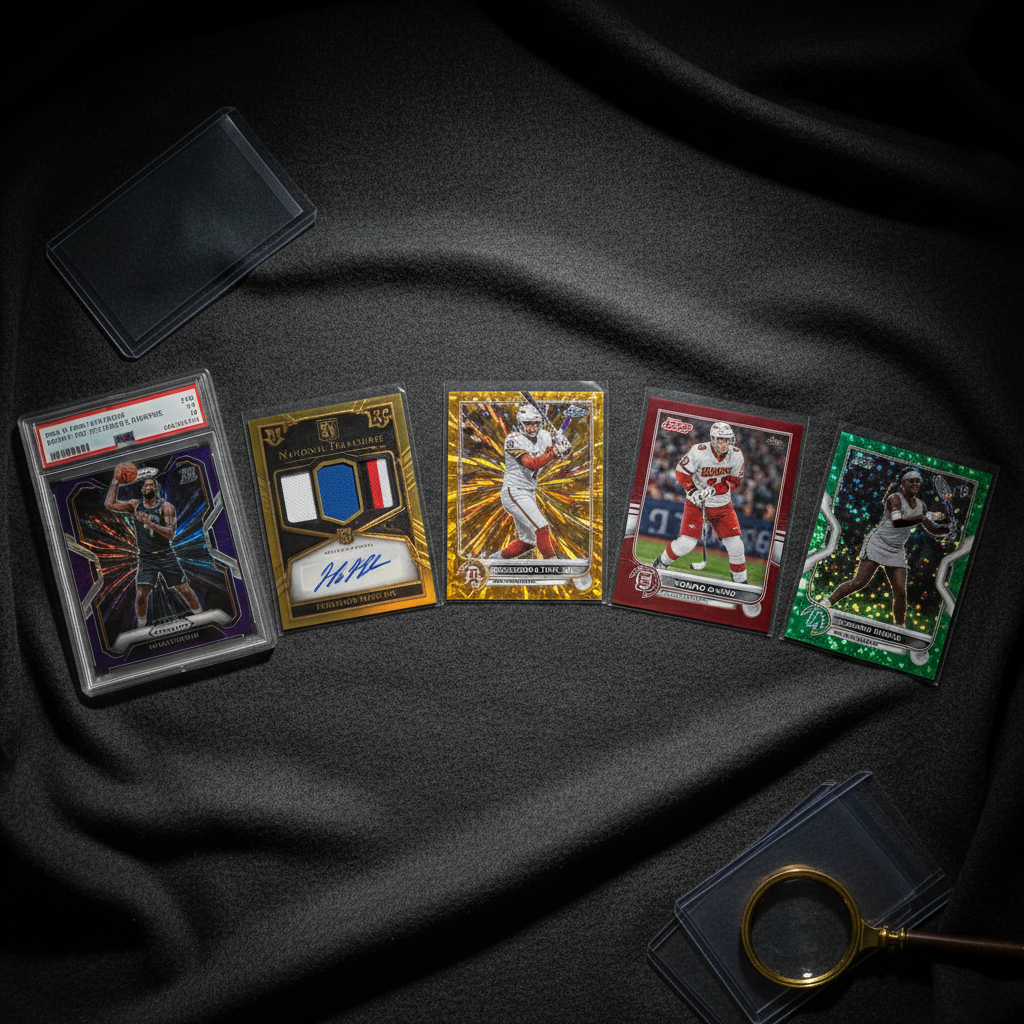
Panini Prizm Gold /10 and Topps Chrome Red Refractors /5 represent the undisputed sovereign debt of modern sports card investing. As print runs for base cards and unnumbered retail variations escalated exponentially between 2018 and 2024, institutional collector capital consolidated around an exceptionally narrow list of canonical, serial-numbered parallels.
This guide is designed for high-conviction collectors and portfolio allocators operating with $200 to $5,000+ budgets who refuse to park capital in manufactured retail noise. We evaluated over 60 modern parallel formats across basketball, football, baseball, and soccer to isolate the five parallels that consistently hold their value, command structural premiums across grading thresholds, and maintain deep liquidity on secondary exchange platforms.
Our methodology strips away aesthetic bias and short-term social media hype. Every selection is benchmarked against five non-negotiable metrics: verified print-run integrity, cross-era brand liquidity, historical gem rate margins (PSA/BGS population control), color-tier hierarchy stability, and the structural price multiplier relative to silver or base rookie comps. If a parallel format does not have at least a decade of institutional collector trust behind its design architecture, it does not make this cut.
How We Picked
- Verifiable Print Run Scarcity (Stamped vs. Unnumbered)
- Historical Value Retention & Market Canonization
- PSA 10 Gem Rate & Condition Sensitivity
- Cross-Sport Brand Liquidity (Prizm vs. Optic vs. Topps Chrome)
- Base-to-Parallel Price Multiplier Ceiling
At a Glance
| Rank | Pick | Best For | Price Range |
|---|---|---|---|
| 1 | 2020 Panini Prizm Football Gold /10 (e.g., Justin Herbert #325) | High-net-worth investors seeking blue-chip liquidity and undisputed modern prestige. | $1,500 - $12,000+ (Tier-dependent; elite QBs reach six figures) |
| 2 | 2018 Topps Chrome Baseball Red Refractor /5 (e.g., Shohei Ohtani #150) | Collectors chasing iconic, low-numbered heritage with an unmistakable visual identity. | $800 - $6,500 raw; $2,500 - $15,000+ PSA 10 |
| 3 | 2019 Panini Donruss Optic Basketball Gold Vinyl /10 (e.g., Ja Morant #168) | Value-focused investors seeking low print runs at a 40% discount to Prizm equivalents. | $350 - $1,800 raw; $1,200 - $5,000 PSA 10 |
| 4 | 2017 Panini Select Field Level Silver Prizm (e.g., Patrick Mahomes #247) | Condition-sensitive collectors who appreciate clean hobby design and historic card architecture. | $200 - $900 raw; $650 - $2,800 PSA 10 |
| 5 | 2022 Topps Flagship Baseball Mother's Day Hot Pink /50 (e.g., Julio Rodriguez #659) | Calculated risk-takers hunting high-grade condition moats on dark-bordered modern cards. | $150 - $750 raw; $900 - $3,500 PSA 10 |
1. 2020 Panini Prizm Football Gold /10 (e.g., Justin Herbert #325)
The undisputed gold standard of modern sports card collecting.
Introduced in 2012, Prizm Gold /10 is the single most liquid and recognized parallel format across basketball and football. In the 2020 Prizm Football checklist, a Gold /10 carries a sustained 40x to 70x multiplier over the raw Silver Prizm, demonstrating unmatched capital concentration at the apex tier.
Best for: High-net-worth investors seeking blue-chip liquidity and undisputed modern prestige.
Price range: $1,500 - $12,000+ (Tier-dependent; elite QBs reach six figures)
Pros
- Universally recognized as the modern sovereign grail tier
- Hard-capped /10 print run offers permanent supply insulation
- Immense institutional liquidity across all major auction houses
Cons
- High capital requirement for marquee players
- Frequently targeted by card doctors for corner and surface touching
2. 2018 Topps Chrome Baseball Red Refractor /5 (e.g., Shohei Ohtani #150)
The preeminent ultra-scarce baseball parallel format of the modern era.
While the SuperFractor 1/1 captures headlines, the Red Refractor /5 is the realistic peak target for elite baseball portfolio builders. With an unbroken continuity spanning two decades, Topps Chrome Red /5 maintains an estimated 8x to 12x price premium over its Gold /50 counterparts, backed by an elite Gem Rate rarely exceeding 45% due to edge sensitivities.
Best for: Collectors chasing iconic, low-numbered heritage with an unmistakable visual identity.
Price range: $800 - $6,500 raw; $2,500 - $15,000+ PSA 10
Pros
- Topps Chrome Red /5 lineage dates back to 2005 with unbroken prestige
- Sub-10 print run creates true market inelasticity
- PSA 10 copies command massive multiples over Orange /25
Cons
- Prone to microscopic white edge flaking straight out of the pack
- Extremely low submission volume makes pricing comps infrequent
3. 2019 Panini Donruss Optic Basketball Gold Vinyl /10 (e.g., Ja Morant #168)
The premier alternative to Prizm, combining true scarcity with iconic design.
Optic Gold Vinyl /10 merges the revered 'Rated Rookie' logo with Panini's most striking optical finish. It consistently trades at an aggressive premium over standard Optic Gold /10 copies, and its strict hobby-box exclusivity guarantees zero retail print-dilution.
Best for: Value-focused investors seeking low print runs at a 40% discount to Prizm equivalents.
Price range: $350 - $1,800 raw; $1,200 - $5,000 PSA 10
Pros
- Stunning cross-hatch visual aesthetic prevents effective counterfeiting
- Consistent 3x-4x multiplier over standard Optic Gold /10
- Optic Rated Rookie branding carries immense heritage weight
Cons
- Optic Chrome stock is notoriously off-center top-to-bottom
- Thicker border design lowers PSA 10 gem rates below 35%
4. 2017 Panini Select Field Level Silver Prizm (e.g., Patrick Mahomes #247)
Tier-based scarcity hiding in plain sight among modern football collectors.
Select's 'Field Level' cards carry estimated print runs roughly 75% smaller than standard Concourse cards, making the unnumbered Field Level Silver effectively as scarce as a numbered parallel. For elite modern subjects, a Field Level Silver in PSA 10 regularly outpaces flagship Prizm Silvers in long-term percentage value growth.
Best for: Condition-sensitive collectors who appreciate clean hobby design and historic card architecture.
Price range: $200 - $900 raw; $650 - $2,800 PSA 10
Pros
- Field Level represents the rarest base tier in the Select checklist
- Higher condition sensitivity creates durable PSA 10 pricing moats
- Significantly lower total pop than flagship Prizm Base or Silver
Cons
- Tiered checklist structure (Concourse vs. Courtside) splits collector demand
- Die-cut variants in adjacent sets sometimes confuse casual buyers
5. 2022 Topps Flagship Baseball Mother's Day Hot Pink /50 (e.g., Julio Rodriguez #659)
Flagship paper scarcity that turns gem grading into an insurmountable moat.
Unlike Chrome parallels where surfaces can be cleaned and polished, Topps Flagship Mother's Day Hot Pink /50 features colored paper stock borders that show every flaw. A PSA 10 copy frequently commands up to a 6x to 8x multiplier over its raw market price due to ultra-low gem counts, rewarding meticulous condition hunters.
Best for: Calculated risk-takers hunting high-grade condition moats on dark-bordered modern cards.
Price range: $150 - $750 raw; $900 - $3,500 PSA 10
Pros
- Strict /50 stamped run creates transparent scarcity on flagship cards
- Tough-to-grade dark pink borders protect PSA 10 population limits
- Topps Flagship design continuity dates back to the 1950s
Cons
- Dark foil borders make PSA 10 gem rates brutal (frequently sub-25%)
- Paper-stock variant susceptible to corner dings during shipping
How to Buy
Sourcing High-End Modern Parallels
Liquidity lives on eBay, PWCC/Fanatics Collect, and Goldin. When hunting high-tier modern parallels, avoid raw singles on unvetted marketplace accounts. Sellers rarely leave an uncirculated Gold Prizm or Red Refractor raw unless it suffers from microscopic surface indentations, roller marks, or soft corners that make a PSA 9 the absolute ceiling. Buy authenticated slabs or purchase raw only through in-person card shows where a 10x illuminated loupe inspection is possible.
Verifying Authenticity and Alterations
Modern foil parallels face two primary integrity risks: color swapping and trim jobs.
- Foil Toning and Stamp Alignment: Inspect serial stamp font kerning against verified PSA/BGS database images. Counterfeiters have occasionally applied foil serial stamps to unnumbered base or silver variations.
- Edge Trimming: Chrome stock is notoriously susceptible to edge shaving to correct factory burrs. Check card dimensions against a known base card from the same set using digital calipers or overlay techniques under magnification.
Grading Economics: When to Submit vs. Hold Raw
For modern serial-numbered parallels, the "PSA 10 Multiplier" dictates your moves:
- The Rule of 3x: If a PSA 10 commands less than 3x the raw card price, buying raw and spending $25-$75 on grading introduces negative expected value (EV) due to Gem Rate risk.
- Tough Condition Stock (e.g., Select, Optic): If gem rates sit below 40%, a PSA 9 still retains roughly 0.9x to 1.1x raw market value, minimizing downside risk while keeping the 3x-5x PSA 10 upside intact.
- True SPs vs. SSPs: For true ultra-rarities (print runs of /10 or less, such as Gold Vinyl or Black Finite), grading serves primarily as encapsulation and authentication. A BGS 9.5 or PSA 9 of a /10 carries nearly full market liquidity, whereas base or unnumbered parallels die financially in anything below a 10.
Common Pitfalls to Avoid
- Parallel Inflation Trap: Panini and Topps now produce over 40 distinct parallels per release. Retail-exclusive, unnumbered parallels (e.g., Green Prizms, Pink Camo, Purple Shock) suffer from hidden print run dilution. Stick strictly to hobby-exclusive, stamped print runs or universally canonized case hits.
- The "Color Match" Premium Mirage: Collectors often overpay by 50% for an unnumbered color match over an actual serial-numbered parallel. Scarcity always outlasts aesthetic trends over a 5-to-10-year horizon.
Frequently Asked Questions
What is the difference between a serial-numbered parallel and a case hit?
A true serial-numbered parallel features a factory-stamped print run (e.g., /10 or /139), guaranteeing finite supply. Case hits like Downtown or Kaboom! are unnumbered short prints (SSPs) calculated strictly on case insertion odds, exposing them to hidden print-run expansion across hobby and retail skus.
Are serial-numbered parallels always better investments than unnumbered variations?
Yes. Unnumbered parallels (Pulsars, Velocities, Ice) fluctuate in supply across mega boxes, blasters, and fat packs. Stamped cards (/25, /10, /1) protect collector capital because supply is permanently hard-capped regardless of total print run surges.
Is a modern parallel ruined if it grades a PSA 9 instead of a PSA 10?
For modern ultra-high-end parallels (/25 or lower), a PSA 9 still commands substantial value—typically 80% to 100% of raw market price—because discerning buyers prioritize authentic ownership of the scarce asset over absolute grade perfection.
Which modern parallel brand commands the highest institutional liquidity?
Panini Prizm Gold /10 is universally viewed as the modern equivalent to the 1993 SP Foil or 1997 Metal Universe PMG. It represents the liquidity standard across football and basketball modern investing.