Best 5 PSA 10 Plays Under $200: Modern Card Gems
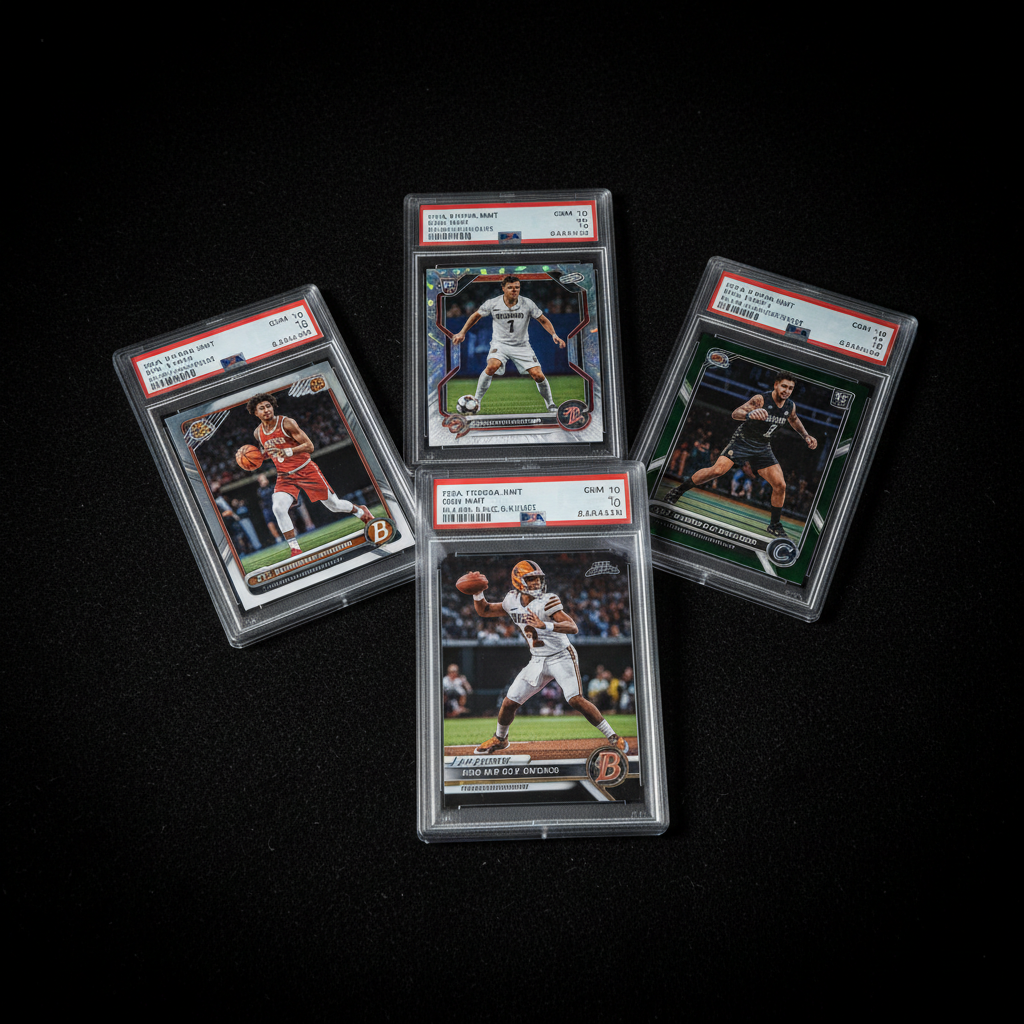
The most asymmetric risk-reward profile in modern sports card collecting sits directly between $100 and $200, where mispriced flagship PSA 10s of generational talent trade for barely more than the all-in cost of raw acquisition and grading fees.
Too many collectors burn capital chasing four-figure speculative lottery tickets or grading bulk base modern singles with negative expected value. This guide isolates five battle-tested, liquid PSA 10 rookie cards and premier modern parallels trading under $200 today. Our selection methodology applies three strict quantitative filters:
- Liquidity Threshold: Minimum 15 verified eBay sales per month to ensure frictionless exits.
- Pedigree Preeminence: Restricted to tier-1 flagship releases (Topps Chrome, Panini Prizm, Donruss Optic) that command sustained institutional hobby demand.
- Downside Cushion: Cards whose current PSA 10 market price sits within 1.5x to 2x of raw replacement cost plus PSA grading overhead ($19-$25 base submission fee + shipping/insurance), functionally placing a structural price floor beneath the slab.
Whether you are deploying a $1,000 monthly bankroll or hunting for your next anchor flip, these five cards provide the optimal intersection of historical stability, elite liquidity, and athletic upside.
How We Picked
- Gem rate & population-to-print-run ratio
- On-field career trajectory and generational ceiling
- Established secondary market liquidity (30-day sales volume)
- Brand equity and flagship status (Topps Chrome/Prizm/Select)
- Cost-to-grade risk buffer vs. raw acquisition costs
At a Glance
| Rank | Pick | Best For | Price Range |
|---|---|---|---|
| 1 | 2018 Topps Update Ronald Acuña Jr. #US250 | Collectors wanting immediate, blue-chip MLB exposure with historic MVP-level milestones already banked. | $40-$60 raw, $140-$175 PSA 10 |
| 2 | 2021 Panini Prizm Ja'Marr Chase #341 | Football investors seeking exposure to the NFL's premier deep-ball threat with a Super Bowl ceiling. | $30-$45 raw, $110-$140 PSA 10 |
| 3 | 2017 Donruss Optic Jayson Tatum #198 | Basketball purists wanting a tier-one cornerstone talent on a perennial championship contender. | $35-$50 raw, $120-$150 PSA 10 |
| 4 | 2018 Donruss Optic Lamar Jackson #167 | Collectors looking for maximum athletic ceiling and generational MVP potential in football. | $40-$55 raw, $140-$170 PSA 10 |
| 5 | 2020 Topps Chrome UEFA Jude Bellingham #76 | Soccer and international sports investors targeting the undisputed global face of football's next era. | $30-$45 raw, $90-$125 PSA 10 |
1. 2018 Topps Update Ronald Acuña Jr. #US250
The modern baseball benchmark trading at a post-injury discount.
Acuña's 2018 Topps Update #US250 is the definitive modern baseball rookie card of the late 2010s. With a gem rate of ~56% and sustained market liquidity, trading in the $140-$175 band puts this card well below its pre-ACL injury peaks above $300. Backing an MVP talent who has already produced a historic 40-home run, 70-stolen base season at this price provides unmatched long-term value.
Best for: Collectors wanting immediate, blue-chip MLB exposure with historic MVP-level milestones already banked.
Price range: $40-$60 raw, $140-$175 PSA 10
Pros
- Flagship Topps Update true rookie with undisputed hobby pedigree
- 40/70 MVP season solidified his first-ballot Hall of Fame career trajectory
- Ultra-liquid asset with multiple daily public auction transactions
Cons
- PSA 10 population is substantial (>13,000), capping sudden supply squeezes.
- Braves team cards carry slight regional demand clustering compared to big-market franchises.
2. 2021 Panini Prizm Ja'Marr Chase #341
Elite wide receiver pedigree at an entry-level modern price point.
Panini Prizm is the undisputed flagship brand for modern football cards, and Chase's #341 represents his premier base rookie release. While quarterbacks dominate hobby headlines, Chase's generational separation ability and permanent tie to Joe Burrow give him the highest floor of any young skill-position star. At roughly $125 in PSA 10, the card trades at roughly 3x raw cost, offering pure gem premium stability.
Best for: Football investors seeking exposure to the NFL's premier deep-ball threat with a Super Bowl ceiling.
Price range: $30-$45 raw, $110-$140 PSA 10
Pros
- Flagship Silver-tier Panini release for modern football card collectors
- Historic offensive rookie output paired permanently with franchise QB Joe Burrow
- Gem rate sits around 52%, insulating it against reckless supply inflation
Cons
- Non-quarterback ceiling in the football card market is traditionally capped.
- Bengals offensive line inconsistency creates seasonal volatility.
3. 2017 Donruss Optic Jayson Tatum #198
Champion pedigree in a chromium Rated Rookie frame.
While Tatum's 2017 Prizm base rookie hovers closer to $250 in PSA 10, his 2017 Donruss Optic Rated Rookie #198 delivers the exact same chromium appeal at an accessible $130-$150 entry point. Tatum has reached Finals MVP-caliber status, entered his prime at age 26, and plays for the NBA's most visible franchise. The Optic card offers tighter population metrics than Prizm while maintaining elite market velocity.
Best for: Basketball purists wanting a tier-one cornerstone talent on a perennial championship contender.
Price range: $35-$50 raw, $120-$150 PSA 10
Pros
- Optic Rated Rookie chromium finish commands elite aesthetic and brand loyalty
- Reigning NBA Champion with perennial First-Team All-NBA credentials
- Significantly lower PSA 10 population than its 2017 Panini Prizm counterpart
Cons
- Eastern conference media coverage occasionally suppresses casual collector hype.
- High volume of modern basketball parallels divides overall collector dollars.
4. 2018 Donruss Optic Lamar Jackson #167
A two-time NFL MVP trading at mid-tier starter pricing.
Two-time NFL MVPs almost never trade below $200 in flagship chromium PSA 10 slabs. Jackson's 2018 Optic #167 gives collectors direct access to his signature Rated Rookie logo. The card's gem rate of roughly 50% reflects common print line and off-centering issues on 2018 Optic stock, ensuring that PSA 10 copies hold legitimate scarcity and premium value over PSA 9s.
Best for: Collectors looking for maximum athletic ceiling and generational MVP potential in football.
Price range: $40-$55 raw, $140-$170 PSA 10
Pros
- Two-time NFL MVP whose legacy is already verified
- Rated Rookie branding provides premier collector recognition over standard paper releases
- Proven market liquidity with consistent weekly auction volume across all platforms
Cons
- Position-player injury risks are inherently higher for scrambling dual-threat QBs.
- High print volume of base 2018 Optic requires sticking strictly to gem mint copies.
5. 2020 Topps Chrome UEFA Jude Bellingham #76
Global soccer royalty on premier Topps Chrome stock.
Jude Bellingham's 2020 Topps Chrome #76 captures his breakthrough Champions League rookie campaign at Borussia Dortmund. At under $125 in a PSA 10, this card trades as an extreme value relative to his global popularity and Real Madrid status. With soccer cards increasingly commanding international institutional capital, holding Bellingham's primary flagship Topps Chrome base card in gem mint condition is one of the smartest sub-$200 bets on the board.
Best for: Soccer and international sports investors targeting the undisputed global face of football's next era.
Price range: $30-$45 raw, $90-$125 PSA 10
Pros
- True UEFA Champions League flagship rookie card for an elite Ballon d'Or contender
- Topps Chrome branding ensures unmatched worldwide collector liquidity
- Sub-$130 pricing provides an extraordinary entry point for Real Madrid's talisman
Cons
- Modern soccer sticker and card markets are splintered across multiple brands.
- Real Madrid rotation and tactical adjustments can cause short-term scoring dips.
How to Buy
Sourcing Strategy: Liquidity Beats Bargain Hunting
When buying sub-$200 PSA 10 slabs, transaction friction can erase gains. Avoid unvetted social media sales where off-center slabs or scratched cases mask underlying flaws. Stick to high-volume secondary platforms: eBay with saved alerts filtered by "Sold Listings" and "Lowest Price", MySlabs for fixed-price inventory with lower seller fees (often passed down as a 5-10% discount), and major auction houses (PWCC/Fanatics Collect, Goldin) during weekly Sunday closures where lower-end modern slabs often slip through unnoticed.
Authenticating Slabs and Avoiding Re-holders
Even at the $150 level, counterfeit PSA slabs and swapped cards exist. Never purchase a slab without verifying the certification number directly on the PSA Cert Verification database. Cross-reference:
- Font alignment and PSA watermark: Counterfeits frequently display thinner text on the front label and muddy fugitive ink on the reverse.
- Lighthouse logo and hologram: Modern PSA slabs feature an embedded light-reactive polymer strip at the base of the label.
- High-resolution scan comparison: Match front/back centering and distinct print dots against the PSA cert scan generated during encapsulation.
Raw vs. Graded Economics: The Sub-$200 Trap
Do not buy raw cards intending to grade them into $150 PSA 10s. Modern bulk grading costs $19–$25 per card at PSA, plus insured shipping both ways (~$5/card amortized across orders). Add a conservative 4-to-6-month capital lockup and an average modern gem rate of 45% to 55%. If you purchase a raw modern chrome card for $40, invest $25 into grading, and land a PSA 9 (selling for $25–$35), you realize an immediate 50% loss. At under $200, buy the pre-graded PSA 10. Let someone else absorb the gem-rate variance and turnaround risk while you lock in liquidity on day one.
Frequently Asked Questions
Is it better to grade raw cards or buy PSA 10s directly under $200?
Buy the PSA 10 directly. Factoring in $19-$25 grading fees, shipping, raw acquisition costs, and modern gem rates (rarely topping 50-60%), cracking or grading raw modern singles to hit a sub-$200 slab offers negative expected value compared to buying pre-graded liquid assets.
Why prioritize flagship sets like Prizm and Topps Chrome over numbered parallels?
Prizm and Topps Chrome are the gold standard for liquidity and investor recognition. While low-numbered cards from niche sets (e.g., Donruss Elite, Certified) carry scarcity, base/refractor flagship PSA 10s from Prizm, Optic, and Topps Chrome generate 10x the daily transaction volume, making exits effortless.
When should you take profit or cut losses on sub-$200 sports card investments?
Track secondary market sales on 130point.com or Market Movers. If the card's 90-day moving average drops 15% without structural changes to the player's career, it is generally noise. However, if a player suffers an injury with long recovery or loses starting status, liquidate into strength rather than holding depreciating base modern paper.
How do I verify the authenticity of a PSA slab under $200?
Always look up the certification number on the official PSA app or website. Verify the micro-printing on the label, examine the embedded PSA light-reactive hologram, and ensure the card centering and surface artifacts match PSA's high-res internal scan.