Best 5 Vintage Cards for First-Time Investors
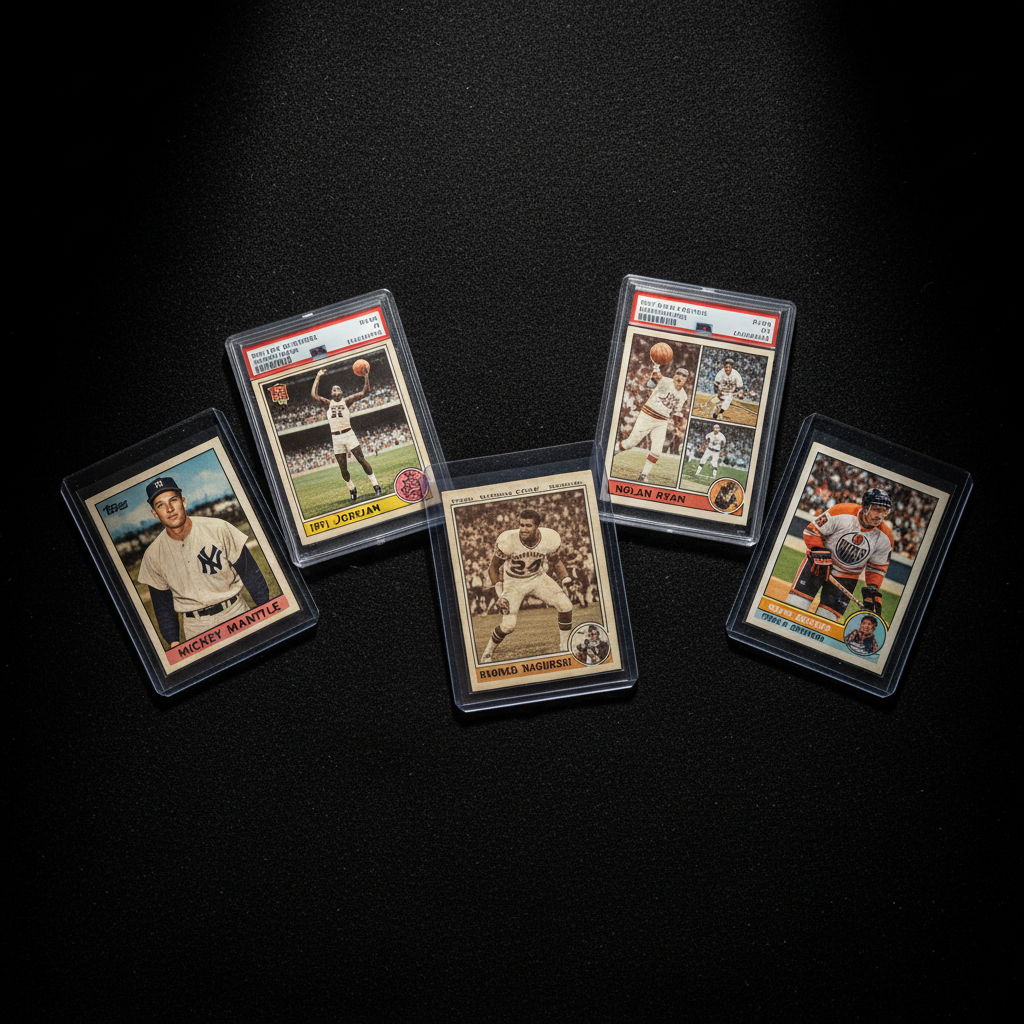
The single safest entry point into alternative asset investing is blue-chip post-war vintage sports cards, where fixed supply meets seven decades of established collector demand. Unlike modern cards—plagued by artificial scarcity, volatile print runs, and rookie hype cycles—vintage cards feature players whose legacies are locked in history and whose surviving populations degrade naturally over time.
This guide evaluates vintage cards specifically for first-time investors entering the market with budgets between $300 and $2,500. Our methodology screens for three non-negotiables: Tier-1 cultural significance, high market liquidity (verifiable through consistent weekly public transactions), and resilient grading pop dynamics across mid-grade tiers (PSA/SGC 3 to 6). We intentionally avoid hyper-inflationary trophies like the 1952 Topps Mickey Mantle or T206 Honus Wagner, which carry prohibitive capital barriers and illiquidity risks for newcomers.
Instead, we identify five bedrock assets that offer immediate liquidity, predictable value retention, and steady historical growth. Whether your objective is hedging against card market volatility or owning irreplaceable pieces of sports history, these are the definitive five vintage issues to anchor your portfolio today.
How We Picked
- Eye Appeal & Centering Sensitivity
- Historical Price Floor Stability
- PSA/SGC Total Population & Liquidity
- Cultural & Historical Player Significance
- Entry-Level Capital Requirement ($300–$2,500)
At a Glance
| Rank | Pick | Best For | Price Range |
|---|---|---|---|
| 1 | 1958 Topps Hank Aaron #30 | Investors wanting maximum blue-chip safety and mainstream cultural liquidity under $1,000. | $450 - $650 (PSA 4) / $800 - $1,150 (PSA 5) |
| 2 | 1971-72 Topps Kareem Abdul-Jabbar #100 | Value-oriented investors targeting high-ceiling vintage basketball in clean mid-grade condition. | $350 - $550 (PSA 5) / $750 - $1,100 (PSA 6) |
| 3 | 1956 Topps Jackie Robinson #30 | Collectors demanding an all-time cultural icon whose market extends far beyond sports. | $1,200 - $1,600 (PSA 3) / $1,900 - $2,600 (PSA 4) |
| 4 | 1971 Topps Roberto Clemente #630 | Condition-sensitive investors looking to exploit grading scarcity in condition-rarity vintage. | $400 - $600 (PSA 5) / $750 - $1,100 (PSA 6) |
| 5 | 1976 Topps Walter Payton Rookie #148 | First-time investors seeking an affordable, iconic card of the consensus football GOAT. | $275 - $400 (PSA 6) / $550 - $800 (PSA 7) |
1. 1958 Topps Hank Aaron #30
The benchmark post-war blue chip for capital preservation.
Hank Aaron's 1958 Topps issue sits at the sweet spot of affordability and institutional prestige. With rookie cards from 1954 routinely pricing out entry-level investors at $4,000+ for mid-grades, the 1958 card captures Aaron immediately following his lone World Series championship and 1957 MVP campaign. In PSA 5 condition, it exhibits consistent auction volume and exceptional multi-decade appreciation with near-zero downside volatility.
Best for: Investors wanting maximum blue-chip safety and mainstream cultural liquidity under $1,000.
Price range: $450 - $650 (PSA 4) / $800 - $1,150 (PSA 5)
Pros
- Hammerin' Hank ranks as baseball's most respected home-run benchmark.
- Stunning dual-color portrait design makes it one of Topps' most visually striking issues.
- Maintains deep secondary market liquidity with daily sales across all platforms.
Cons
- Relatively high total population across all grades (over 6,000 PSA graded).
- Background yellow tinting frequently suffers from print snow and registration blur.
2. 1971-72 Topps Kareem Abdul-Jabbar #100
The undisputed cornerstone of 1970s basketball vintage.
While Lew Alcindor's 1969 tall-boy rookie requires heavy capital, his 1971 Topps issue is historically pivotal: it commemorates his formal transition to Kareem Abdul-Jabbar alongside his first NBA Championship. Kareem holds six MVP awards and six rings, yet his early Topps cards trade at a dramatic discount compared to equivalent tier-1 legends in baseball and hockey. It remains one of the most asymmetric risk/reward profiles in post-war vintage.
Best for: Value-oriented investors targeting high-ceiling vintage basketball in clean mid-grade condition.
Price range: $350 - $550 (PSA 5) / $750 - $1,100 (PSA 6)
Pros
- First card featuring his official name change from Lew Alcindor.
- Historic 1971 season: Kareem won his first NBA title, Finals MVP, and regular season MVP.
- Massively undervalued relative to contemporaries like Wilt Chamberlain and Bill Russell.
Cons
- Thin, low-grade card stock prone to heavy corner creasing.
- Centering issues plague over 70% of the surviving population.
3. 1956 Topps Jackie Robinson #30
The definitive cultural centerpiece for any serious collection.
Jackie Robinson is one of the very few vintage subjects with enduring non-sports cultural demand, providing an unshakeable price floor. The 1956 Topps issue features magnificent dual-imagery (a stunning portrait paired with his iconic home-plate slide) and marks the final card issued during his playing career. A PSA 3 or 4 offers tremendous eye appeal and liquidity that institutional auction houses actively seek for thematic sales.
Best for: Collectors demanding an all-time cultural icon whose market extends far beyond sports.
Price range: $1,200 - $1,600 (PSA 3) / $1,900 - $2,600 (PSA 4)
Pros
- Final active playing-career card issued for Jackie Robinson.
- Universally considered one of the top five most beautiful Topps cards ever designed.
- Unrivaled historical importance transcending American sports culture.
Cons
- High entry-level cost even in lower collector grades.
- Susceptible to edge wear on the horizontal format and delicate green borders.
4. 1971 Topps Roberto Clemente #630
The ultimate test of vintage condition scarcity and timeless appeal.
The 1971 Topps black borders are legendary for edge chipping, making clean mid-grades inherently scarce. Card #630 captures Clemente following his legendary 1971 World Series MVP performance, just a year prior to his tragic passing. The built-in supply constraint of surviving mid-grades (PSA 6 pop represents just a fraction of earlier flagship cards) provides robust downside support and high upside if sourced with sharp corners.
Best for: Condition-sensitive investors looking to exploit grading scarcity in condition-rarity vintage.
Price range: $400 - $600 (PSA 5) / $750 - $1,100 (PSA 6)
Pros
- Iconic, notoriously tough black-bordered set design.
- High-series scarcity combined with Clemente's legendary 1971 World Series MVP season.
- Low pop counts in mid-to-high grades create inherent structural pricing protection.
Cons
- Condition sensitive: black borders show chipping from even minor micro-touches.
- PSA 7s and above escalate exponentially in cost due to paper fragility.
5. 1976 Topps Walter Payton Rookie #148
The most liquid vintage football investment card in existence.
Vintage football typically trades at a discount to baseball, giving investors elite pedigree at accessible price points. Walter Payton's 1976 Topps rookie is the definitive NFL card of the 1970s, celebrating the man who held the all-time rushing crown for nearly two decades. In PSA 6 or 7, this card trades dozens of times per month across eBay and major auction houses, delivering unrivaled liquidity and steady capital preservation for under $1,000.
Best for: First-time investors seeking an affordable, iconic card of the consensus football GOAT.
Price range: $275 - $400 (PSA 6) / $550 - $800 (PSA 7)
Pros
- The uncontested premier football rookie card of the 1970s.
- Walter Payton represents universally revered NFL royalty with zero character risk.
- Accessible entry point in PSA 6 or 7 with very high resale turnover.
Cons
- High overall print run compared to 1950s and 1960s releases.
- Requires strict inspection for factory print defects and vertical print lines.
How to Buy
Where to Source Safely
Vintage sports cards carry significant counterfeiting and alteration risk (trimming, pressing, recoloring). Never purchase high-value vintage raw on platforms without buyer guarantees. Stick to established auction houses like Heritage Auctions, Robert Edward Auctions (REA), and PWCC/Fanatics Collect for cards exceeding $1,000. For eBay, filter strictly for listings covered by the eBay Authenticity Guarantee (blue checkmark), where cards over $250 are routed to third-party authenticators before reaching your doorstep.
How to Verify Authenticity and Slabs
Even encapsulated cards face fraud via compromised slab shells. Always cross-reference the certification number and barcode on PSA’s, SGC’s, or BVG’s mobile verification apps. Look for:
- Frosting and Glue Marks: Inspect the slab perimeter seams for milky frosting, which signals cracking and re-sealing.
- Slab Era Nuance: Modern light-house PSA labels feature embedded UV watermarks and fugitive ink. For vintage, SGC's black tuxedo holder is widely respected and often trades at parity in grades 1 through 5, occasionally offering a 10–15% discount against PSA that presents immediate buying value.
When to Grade vs. Hold Raw
Unless you possess a lighted loupe, micrometer, and decades of experience spotting vintage stock restoration, do not buy raw vintage cards to grade yourself. The modern raw vintage market is extensively cherry-picked; the probability that an ungraded 1958 Hank Aaron on eBay earns a clean numerical grade without receiving an "Altered" or "Authentic" designation is less than 10%. Buy the card already graded by PSA or SGC, and buy the card, not the holder—prioritizing eye appeal and clean centering over a technical grade bump.
Common Pitfalls to Avoid
- Chasing High Technical Grades with Awful Centering: A PSA 5 with 90/10 centering will consistently underperform a centered, vibrant PSA 4 at resale. Eye appeal commands liquidity.
- Paper Loss Hidden by Sleeves: Minor back paper loss from scrapbook removal reduces cards directly to a PSA 1. Verify scans of the reverse side.
- Ignoring Population Distribution: Be wary of vintage cards where population counts peak at mid-grades without genuine structural scarcity; supply absorbs demand shocks far worse than elite Hall of Fame issues.
Frequently Asked Questions
Why does eye appeal matter more than the numerical grade in vintage cards?
Eye appeal dictates true market value in vintage. A PSA 4 with 55/45 centering and vibrant color will frequently outsell an off-center or dull PSA 5 by 15% to 30%. Never buy vintage blindly by the number on the slab; prioritize registration, focus, and centering.
Is SGC grading acceptable for vintage investments, or should I only buy PSA?
For pre-1970 cards, SGC (the 'Tuxedo' holder) is considered an industry standard alongside PSA. SGC grades 1 through 6 trade near parity with PSA, often with faster turnaround times and superior visual contrast on dark borders. For resale liquidity, PSA holds a slight price premium, but SGC is fully respected by high-end auction houses.
How much capital do I need to start investing in vintage sports cards?
$1,000 is an ideal threshold. It comfortably buys mid-grade staples such as a 1958 Topps Hank Aaron in PSA 5, a clean 1956 Topps Jackie Robinson in PSA 3, or a sharp 1971 Topps Roberto Clemente in PSA 6. Focus your capital on one iconic card rather than spreading it across five low-impact raw cards.
Why invest in vintage sports cards instead of modern ultra-modern rookies?
Modern cards rely on ongoing player performance, artificial serial numbering, and speculation, exposing buyers to steep 80%+ drawdowns. Vintage cards feature deceased or retired legends whose career statistics and legacies are permanent, backed by organic scarcity through natural decades-long attrition.