The 5 Best Rookie Patch Auto Cards for Football Investors in 2024
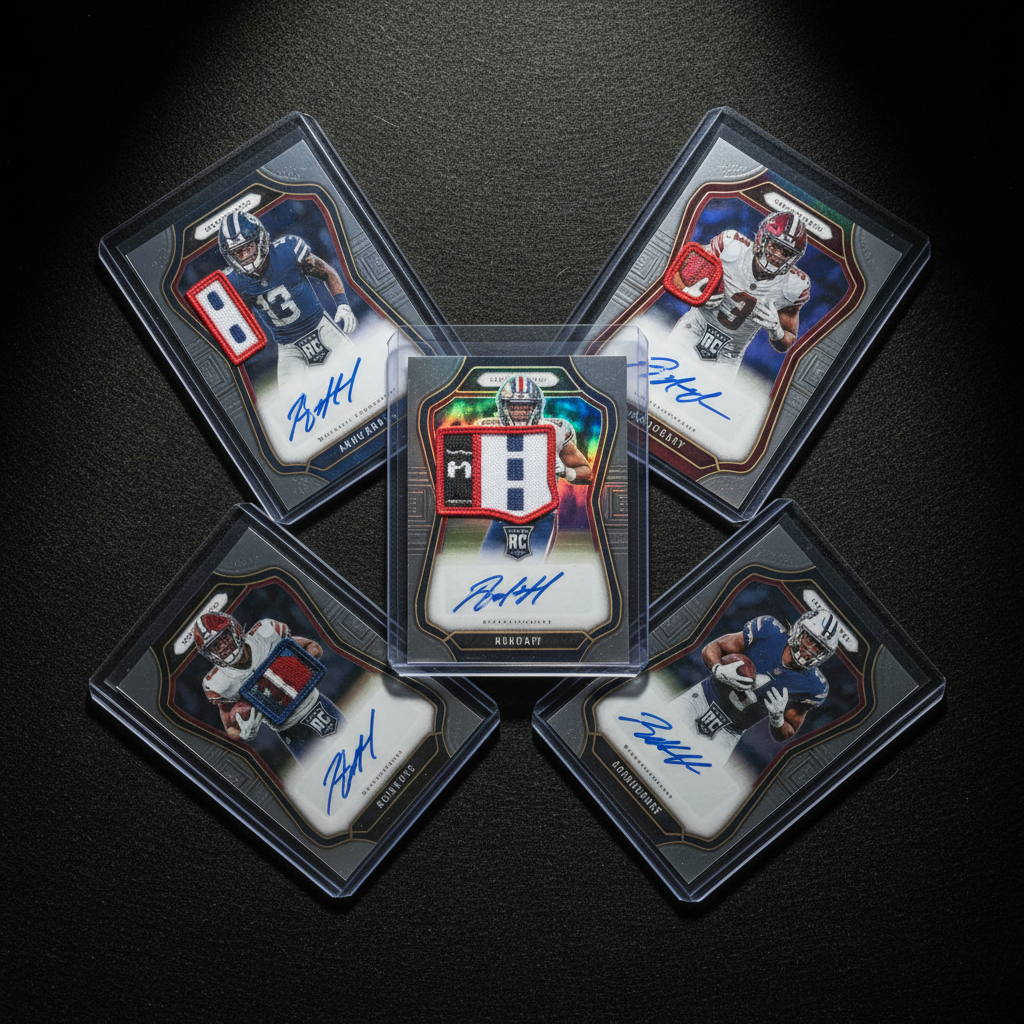
The modern football card market has one king: the Rookie Patch Autograph (RPA). For serious investors, a player's flagship RPA is the single most important and liquid asset you can own. This guide bypasses the noise of fleeting trends and focuses on the five most compelling, investment-grade RPAs on the market today for budgets between $500 and $5000.
We evaluated dozens of players and sets, prioritizing assets from flagship brands like Panini National Treasures and Immaculate. Our methodology weighted player trajectory and market-proven performance, on-card autographs, multi-color patch potential, and population scarcity. These are not just collectibles; they are strategic investments in the NFL's most marketable stars. Our top pick is the single most important modern football card you can own, while other selections offer compelling risk/reward profiles for different types of investors.
How We Picked
- Set & Brand Prestige
- Player Ceiling & Market Hype
- Patch Quality & Aesthetics
- Population Scarcity (Print Run & PSA 10 Pop)
- Market Liquidity & Proven Sales
At a Glance
| Rank | Pick | Best For | Price Range |
|---|---|---|---|
| 1 | 2020 Panini National Treasures #156 Joe Burrow RPA /99 | The investor who wants the single most important and stable modern football card in their portfolio. | $3,500-$5,000+ (graded) |
| 2 | 2023 Panini National Treasures #153 Anthony Richardson RPA /99 | The investor with a higher risk tolerance looking for explosive growth potential. | $1,500-$2,500 (graded) |
| 3 | 2020 Panini Immaculate Collection #104 Justin Herbert RPA /99 | The investor who wants a proven, elite QB in a high-end set without paying the absolute top-of-market price. | $1,800-$3,000 (graded) |
| 4 | 2020 Panini National Treasures #160 Justin Jefferson RPA /99 | The investor looking to diversify their football card portfolio with a blue-chip player at a skill position. | $1,000-$1,800 (graded) |
| 5 | 2020 Panini Flawless Collegiate #10 Jalen Hurts RPA /25 | The investor who wants the prestige and scarcity of an ultra-premium brand with an elite player, but is working with a sub-$1000 budget. | $500-$900 (graded) |
1. 2020 Panini National Treasures #156 Joe Burrow RPA /99
The Modern Blue Chip
This is the 1952 Topps Mantle of the modern football card era. As the flagship RPA from the hobby's most prestigious set for a consensus top-3 NFL quarterback, the Burrow NT is the ultimate trophy card and a pillar of the market. With a PSA 10 population of just 21 (as of late 2023), its scarcity-to-demand ratio is unmatched, ensuring its status as a benchmark asset for years to come.
Best for: The investor who wants the single most important and stable modern football card in their portfolio.
Price range: $3,500-$5,000+ (graded)
Pros
- The single most desirable modern football card.
- Extremely scarce in high grades.
- Features a proven, elite top-tier QB.
- Highest market liquidity and price stability.
Cons
- Highest price point in this guide; may be prohibitive for some.
- Market is mature, offering less explosive upside than a rising prospect.
2. 2023 Panini National Treasures #153 Anthony Richardson RPA /99
The High-Risk, High-Reward Moonshot
Investing is about buying low, and Anthony Richardson's season-ending injury created a significant discount on his top-tier RPA. Before the injury, his electrifying play had his market soaring. This card represents a ground-floor opportunity to acquire the flagship RPA of a player with a potential MVP ceiling at a fraction of what it will be if he realizes that potential. The risk is high, but the upside is the greatest in this guide.
Best for: The investor with a higher risk tolerance looking for explosive growth potential.
Price range: $1,500-$2,500 (graded)
Pros
- Massive upside potential if he becomes a superstar.
- Currently undervalued due to injury.
- Flagship RPA from the premier National Treasures set.
- Player possesses a rare combination of arm talent and athleticism.
Cons
- Significant risk due to injury history and small sample size.
- If his return is unsuccessful, the card's value could decrease substantially.
3. 2020 Panini Immaculate Collection #104 Justin Herbert RPA /99
The 'Value' Superstar QB
While Joe Burrow's National Treasures RPA gets the headlines, Justin Herbert's Immaculate RPA offers a chance to invest in an elite, established top-5 QB at a more accessible price. Immaculate is a true high-end set with a sterling reputation for jumbo patches and on-card autos. You get all the hallmarks of a premium, investment-grade card—a great player, great brand, and scarcity—without the extreme premium of the absolute #1 card on the market.
Best for: The investor who wants a proven, elite QB in a high-end set without paying the absolute top-of-market price.
Price range: $1,800-$3,000 (graded)
Pros
- Features an elite, proven NFL quarterback.
- High-end set with jumbo patch potential.
- Trades at a significant discount to his National Treasures RPA.
- Strong secondary market liquidity.
Cons
- Immaculate is a tier below National Treasures in brand prestige.
- Less potential for exponential growth than a prospect card.
4. 2020 Panini National Treasures #160 Justin Jefferson RPA /99
The Best Non-QB Bet
Diversifying beyond quarterbacks is a smart portfolio strategy, and there is no better non-QB to own than Justin Jefferson. This is the flagship RPA for the undisputed #1 wide receiver in the NFL, a generational talent who drives significant market interest. For a position player to command this level of value speaks to his dominance, making this a relatively safe investment with a strong collector base.
Best for: The investor looking to diversify their football card portfolio with a blue-chip player at a skill position.
Price range: $1,000-$1,800 (graded)
Pros
- The premier RPA of the best wide receiver in the NFL.
- Diversifies an investment portfolio away from being QB-only.
- Strong brand recognition of National Treasures.
- Player's exciting play style keeps him in the national spotlight.
Cons
- Non-QBs have a lower value ceiling than their quarterback counterparts.
- Value is tied to a single player's health and performance.
5. 2020 Panini Flawless Collegiate #10 Jalen Hurts RPA /25
The Affordable Entry into Ultra-Premium
This card offers a savvy entry point into the ultra-premium market. Flawless is one of the most expensive and revered products Panini makes, but because this RPA features Jalen Hurts in his college uniform, it trades at a steep discount to his pro-uniform cards. It allows an investor to acquire a low-print run RPA (numbered to just 25) of an MVP-caliber quarterback from an elite brand, making it one of the most undervalued assets in the high-end space.
Best for: The investor who wants the prestige and scarcity of an ultra-premium brand with an elite player, but is working with a sub-$1000 budget.
Price range: $500-$900 (graded)
Pros
- Ultra-premium brand (Flawless) at an accessible price.
- Very low print run of just 25 copies.
- Features an elite, MVP-caliber quarterback.
- Massive value jump if collectors pivot to collegiate cards over time.
Cons
- Collegiate uniforms carry a permanent discount vs. NFL unis.
- Smaller collector base for college-themed cards.
How to Buy
'''### How to Safely Acquire Your Next RPA Investment
Navigating the world of high-end football cards requires diligence. Here’s how to buy with confidence.
Where to Source Your Cards
- eBay: The largest marketplace. Vet your sellers rigorously. Only buy from established accounts with 99.5%+ positive feedback and a long history of selling similar items. Scrutinize high-resolution photos for any flaws.
- MySlabs: A fixed-price marketplace popular with experienced collectors. It offers lower fees than eBay, which often translates to better prices for the buyer.
- Auction Houses (Goldin, PWCC, Heritage): For the highest-end assets, major auction houses provide vetting, marketing, and a large audience of serious buyers. Prices can be strong, but you can buy with a high degree of confidence.
Grading Economics: When to Grade vs. Buy Graded
A raw card is a lottery ticket. A graded card is a known quantity. Always assume a raw card will not grade Gem Mint.
- Buying Graded: For RPAs, we strongly recommend buying cards already graded by PSA or BGS. This guarantees authenticity and provides a clear, universally understood measure of condition. You are buying the card, not the gamble.
- Submitting for Grading: Only consider submitting a raw RPA for grading if it looks absolutely pristine upon close inspection with a magnifying glass. Check for perfect 60/40 centering or better, razor-sharp corners, clean edges, and a flawless surface. With grading fees for RPAs ranging from $50-$200+, a grade of BGS 9 or PSA 9 is often required just to break even. The real money is in the PSA 10 or BGS 9.5, which can command a 2x to 5x premium over a raw card's price.
Common Pitfalls to Avoid
- Sticker Autographs: For investment-grade RPAs, demand on-card autographs. Sticker autos are applied after production and are far less desirable, trading at a significant discount.
- "Player-Worn" vs. "Game-Used" Patches: Read the back of the card. "Player-worn" or "event-worn" material was not used in an actual NFL game and is far less desirable than "game-used" material. Price accordingly.
- Patch Quality: Not all patches are equal. A single-color, plain-jersey patch is the least desirable. A multi-color patch with stitching, part of a logo, or the iconic NFL Shield commands a massive premium. Always factor patch "eye-appeal" into the price.'''
Frequently Asked Questions
Are sticker autos ever worth investing in?
For high-end RPAs, on-card autographs are the standard. While some sticker auto cards can have value, they will almost always have a lower ceiling and less liquidity than their on-card counterparts from the same set. We advise focusing on on-card autos for serious investments.
What's more important: the player or the brand of the card?
Player first, always. A superstar's card from a mid-tier set will always be a better investment than a third-string player's card from a high-end set like National Treasures. The ideal combination, and what this guide focuses on, is a great player in a great set.
Should I prefer a BGS 9.5 or a PSA 10?
In today's market, a PSA 10 generally commands the highest price premium for modern cards. However, a BGS 9.5 with strong subgrades (e.g., all 9.5 or higher) is considered by many collectors to be on par or even superior. Both are considered 'gem mint' and are excellent, investment-worthy grades.
Why are RPAs numbered to /99 considered the standard?
The /99 print run for flagship sets like National Treasures hits a sweet spot. It's low enough to be verifiably scarce but high enough to have a presence in the market, allowing for price discovery and liquidity. Lower print runs (e.g., /49, /25, 1/1) command higher prices, but the /99 is the most recognized and traded benchmark.