How to Spot a Fake Rookie Card: The Definitive Guide
How to Spot a Fake Rookie Card: The Definitive Guide
The thrill of uncovering a high-value rookie card is a cornerstone of the hobby. But in a market driven by billion-dollar valuations, that thrill can quickly curdle into the gut-wrenching realization that your prized possession is a worthless fake. For the serious investor, learning to identify counterfeit cards isn't just a skill—it's essential portfolio protection.
The sports card market boom has created a parallel, shadow industry of forgers. From vintage grails to modern Prizms, sophisticated criminals are leveraging new technology to prey on unsuspecting collectors. This guide provides a systematic, data-driven approach to authenticating rookie cards, moving from simple physical checks to the microscopic details that forgers almost always get wrong.
The Forger's Playbook: Common Targets and Why They're Chosen
Counterfeiters focus on cards where the ratio of market value to production complexity is most favorable for them. These are often the most iconic and liquid cards in the hobby.
The Holy Grails:
- 1986-87 Fleer Michael Jordan #57: The undisputed king of counterfeits. Its high value, mainstream recognition, and relatively simple 1980s printing technology make it a prime target.
- 1952 Topps Mickey Mantle #311: The post-war grail. The sheer value, even in low grades, incentivizes forgeries.
- 1979 O-Pee-Chee Wayne Gretzky #18: The Great One's rookie is plagued by fakes, often distinguished by subtle print differences from its Topps counterpart.
- 1989 Upper Deck Ken Griffey Jr. #1: As the most iconic card of the "junk wax" era, its widespread appeal and the desire to own a perfect "10" version make it a common fake.
Modern Menaces:
- 2003-04 Topps Chrome LeBron James #111: The modern equivalent of the Jordan rookie, its chromium finish presents a challenge for forgers, but the massive value motivates them to try.
- 2018-19 Panini Prizm Luka Doncic #280 (Silver Prizms): High-value modern Prizms are increasingly targeted, often with fakes that mimic the refractor effect poorly.
- 2000 Playoff Contenders Tom Brady Championship Ticket #144 (Autographed): For high-end autographed cards, forgers will attempt to replicate both the card and the signature, a double deception.
By tracking the value of these cards using tools like the HobbyAlpha Market Outlook, you can directly see which assets are appreciating most, which in turn helps you understand their risk profile for counterfeiting.
Level 1 Authentication: The "Feel" Test and Basic Checks
These initial checks will weed out low-quality fakes. While they won't catch sophisticated forgeries, they are a crucial first line of defense.
- Card Stock & Rigidity: Authentic cards have a specific stiffness and texture. Fakes often feel flimsy, waxy, overly glossy, or strangely matte. A gentle flex of the card (don't fold it!) can reveal a lack of rigidity common in cheaper counterfeit stock.
- Size and Cut: Compare the suspect card to a "common" card from the same set. The dimensions should be identical. Are the corners rounded with the same precise radius? Forgers using cheaper equipment often produce cards with slightly different dimensions or imperfectly rounded corners.
- Color and Brightness: Fakes often suffer from color inaccuracies due to the scanning and reprinting process. Colors may be oversaturated, washed out, or simply the wrong hue. A classic example is the Chicago Bulls logo on a fake '86 Fleer Jordan, where the red is often a bright, almost orange-red instead of the correct deep red.
- The Smell Test: This may sound odd, but it's a valid technique. Vintage cardboard from the 50s through the 80s has a distinct, aged paper smell. A counterfeit fresh off a modern inkjet or laser printer will smell like chemicals or have no smell at all.
Level 2 Authentication: The Loupe is Your Best Friend
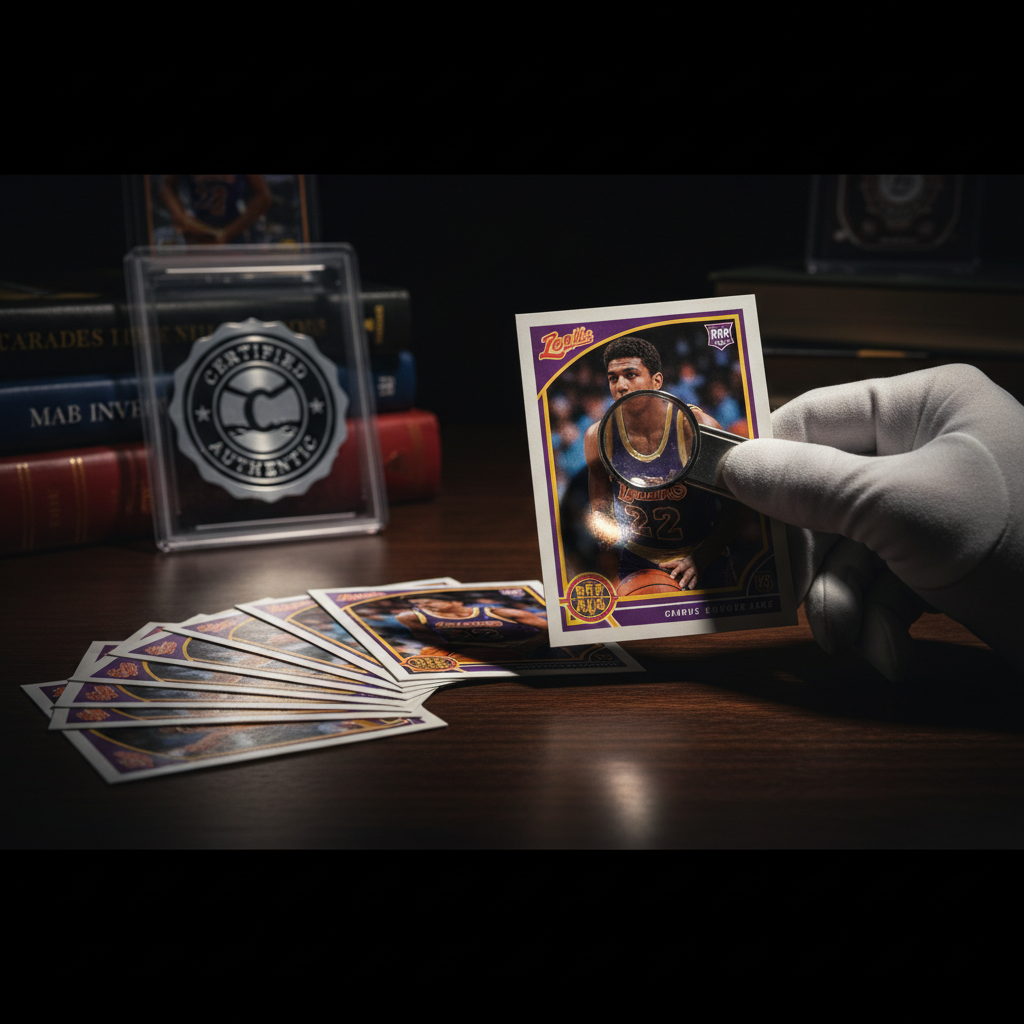
This is where more than 95% of fakes are definitively identified. A jeweler's loupe is the single most important tool for any serious card investor. A 10x magnification loupe is the minimum requirement; a 30x loupe is even better.
The #1 Indicator: Printing Patterns
Vintage and most modern cards are printed using offset lithography, which creates an image out of tiny dots of ink arranged in a "rosette" or circular pattern. Typically, these are Cyan, Magenta, Yellow, and Black (CMYK) dots.
Authentic Cards: When viewed under a loupe, a real card will show a clear, uniform rosette pattern in the colored areas. Critically, black text and solid black lines were often printed with a separate, solid black plate. This means the black text should appear solid and crisp, not made up of tiny colored dots.
Counterfeit Cards: Fakes are usually created by scanning a real card and reprinting it. This process fails to replicate the original printing method. Under a loupe, a fake will often display:
- A "fuzzy" or blurry dot pattern.
- A grid-like dot structure instead of a rosette.
- Solid-looking color where there should be dots.
- The Telltale Sign: Black text (like the player's name or stats on the back) that is made up of a composite of CMYK dots instead of being solid black. This is a dead giveaway for a scanned fake.
Example: The '86 Fleer Jordan RC: Place a loupe over the red border on the front. On a real card, you will see a clear pattern of magenta and yellow dots. Now, look at the black outline of the nameplate. It should be a solid black line. Many fakes will have a muddy-looking red border and a black line composed of fuzzy, multi-colored dots.
Sharpness of Logos and Text
Examine small, detailed areas like the team logo, the brand mark (e.g., Topps, Fleer), and the player's name. On an authentic card, these elements are printed with precision and are exceptionally crisp. On a fake, they often appear slightly blurry, with soft or poorly defined edges—an unavoidable artifact of the scanning process.
The Economics of Fakes vs. Grading
Understanding the financial incentives reveals why buying raw, high-value cards is so risky. Let's use the 1989 Upper Deck Ken Griffey Jr. RC #1 as a case study.
- Market Value (Approximate):
- Raw "Near Mint" on eBay: ~$50
- PSA 8 Grade: ~$100 (ROI after grading: ~33%)
- PSA 9 Grade: ~$250 (ROI after grading: ~233%)
- PSA 10 Grade: ~$2,000+ (ROI after grading: >2,500%)
The Forger's Math: A convincing fake can be printed for less than $1. The forger lists it on an open marketplace for $50. An optimistic buyer, dreaming of a PSA 10, snaps it up. The forger makes a quick, nearly 100% profit.
The Buyer's Loss (The "Grading Trap"):
- Cost of raw card: $50
- Cost of grading services (PSA/BGS): ~$25
- Total Investment: $75
Weeks later, the card is returned by the grading company with the designation "Questionable Authenticity." The buyer has lost $75 and is left with a worthless piece of cardboard. The premium paid for a professionally graded card isn't just for the condition assessment; it's for the expert authentication. The HobbyAlpha Card Advisor tool can help you analyze the ROI of buying pre-graded cards versus taking the risk on raw cards, factoring in these very real dangers.
Case Study: Deconstructing a Fake 1986-87 Fleer Michael Jordan
A side-by-side comparison reveals the common flaws in a counterfeit Jordan RC.
| Attribute | Authentic #57 | Common Fake #57 |
|---|---|---|
| Printing (Loupe) | Clear rosette dot pattern. Black text and lines are solid black. | Blurry, fuzzy, or grid-like dot patterns. Black text is often comprised of CMYK dots. |
| Bulls Logo | Crisp lines, correct deep red color. Details within the logo are sharp. | Fuzzy edges, often a brighter orange/red hue. Lack of fine detail. |
| Fleer Crown Logo | Bright, vibrant "taxi cab" yellow. The points of the crown are distinct. | Often a dull, muddy, or greenish-yellow. Points may appear rounded or blurry. |
| Scoring Arrow (Back) | The tip of the arrow is a distinct magenta/red color within a clean blue circle. | The arrow tip is often a solid red, blurry, or bleeds into the surrounding blue circle. |
| Copyright Info (Back) | All text, including the "© 1986 FLEER CORP." is sharp and perfectly legible. | Text is often fuzzy, broken, or appears filled-in under magnification. |
| Card Gloss | A distinct semi-gloss finish is present on the front. | Can be excessively glossy (like a photograph) or completely flat/matte. |
Sophisticated Fakes: The Danger of Counterfeit Slabs
The most deceptive fakes involve not just a counterfeit card, but a counterfeit graded holder (slab) as well. The forger's goal is to trick a buyer into believing the card has already been authenticated by PSA, BGS, or another trusted grader.
How to Spot a Fake Slab:
Verify the Certification Number: This is the most crucial step. Every graded card has a unique serial number or QR code on its label. Go to the grading company's official website (e.g., PSA's Cert Verification page) and enter the number. Does the card in their database match what you are holding? Check the player name, set, card number, and most importantly, the photo. Some forgers use a real cert number but put a different, lower-quality card in a fake slab.
Examine the Slab Itself: Real slabs from major companies like PSA have specific security features. The edges are sealed with a distinct sonic weld pattern that looks "frosted." Fakes may be glued together, show messy seams, or use a different, less precise sealing method. Real slabs are also made of a specific, high-quality plastic that is hard to replicate.
Inspect the Label: Look at the label font, holograms, and overall print quality. Compare it side-by-side with a known authentic slab from the same grading era. Forgers often struggle to perfectly replicate the proprietary fonts and security features on the label itself.
Conclusion: Your Best Defense is Due Diligence
Protecting your investments from the growing threat of counterfeits comes down to a clear, repeatable process: start with the physical "feel" tests, escalate to microscopic loupe analysis of the print pattern, and always, always verify the certification number of a graded slab. Trust your gut, but confirm with data and tools.
Learning authentication is your best defense against catastrophic loss. As you hunt for the next centerpiece of your collection, arm yourself with knowledge. Use HobbyAlpha's data tools like Daily Alpha and Hidden Gems to identify smart investment opportunities from trusted sources, but never skip your own due diligence. The best collectors are the most informed collectors.
Frequently Asked Questions
What's the most commonly counterfeited rookie card?
The 1986-87 Fleer Michael Jordan #57 is by far the most targeted. Its high value and iconic status make it a prime candidate for forgers. Other frequent targets include the 1952 Topps Mickey Mantle, 1989 Upper Deck Ken Griffey Jr., and modern hits like the 2003-04 Topps Chrome LeBron James.
Is it safe to buy raw (ungraded) rookie cards online?
It carries significant risk, especially for high-value cards. While deals can be found, the probability of encountering fakes, altered cards, or simply cards that won't grade well is high. We recommend buying professionally graded cards from reputable sellers or using a tool like HobbyAlpha's Card Advisor to vet potential raw purchases.
Can a fake card still get a high grade from PSA or BGS?
It's extremely unlikely but not impossible for a very sophisticated fake to fool a grader initially. However, grading companies have extensive databases and use advanced technology to detect fakes. More commonly, counterfeiters will fake the entire graded slab, not just the card. This is why verifying the certification number on the grading company's official website is a crucial step.
What is a 'reprint' card and how is it different from a counterfeit?
A reprint is a legitimate reproduction of a card, often released by the original manufacturer or a licensed third party for commemorative purposes. They are typically marked as 'reprint' or have different sizing/stock. A counterfeit (or fake) is a forgery created with the intent to deceive a buyer into thinking it's the authentic, original card. Counterfeits are illegal and worthless.
What's the best tool to use to check for fakes?
The single best tool is a jeweler's loupe with at least 10x magnification, preferably 30x. This allows you to examine the print patterns, which is the most reliable way to distinguish a real card from a fake. No app or software can replace the physical examination of the card's printing.
Does HobbyAlpha's 'Hidden Gems' feature screen for fakes?
Our 'Hidden Gems' tool identifies undervalued cards based on market data, population reports, and player performance. While we filter our analysis to primarily graded cards from trusted sources, the ultimate responsibility for authentication lies with the buyer and the grading company. We provide the data to help you make an informed decision, and this guide provides the authentication skills you need.