How to Spot Fake Sports Cards: The Definitive 2024 Investor Guide
How to Spot Fake Sports Cards: The Definitive Investor's Guide
The thrill is universal: you finally acquire a grail rookie card—a 1986 Fleer Michael Jordan, a 2000 Bowman Chrome Tom Brady, a 2017 Panini Prizm Patrick Mahomes II. The potential ROI is astronomical. But then, a nagging doubt creeps in. The gloss is a little off. The corner feels too sharp. The horror dawns: you've sunk thousands into a worthless piece of counterfeit cardboard.
In today's white-hot sports card market, counterfeiting isn't a niche problem; it's a multi-million dollar industry. As valuations soar, the incentive for fraud grows in lockstep. But for the informed investor, risk can be managed. This is your definitive guide to identifying fakes, protecting your capital, and investing with data-driven confidence.
Why Fakes Are Flooding the Market
The current boom, what we call the "Cardboard Gold Rush," has made top-tier rookie cards as liquid as many traditional assets. This liquidity, tracked on HobbyAlpha's Market Outlook, attracts bad actors. The reasons for the surge in fakes are simple economics:
- High Profit Margins: A counterfeiter can print a fake 1986 Fleer Jordan for pennies on the dollar and attempt to sell it for thousands. The arbitrage is immense.
- Technological Advancement: Professional-grade printers and scanners can now replicate vintage and modern cards with terrifying accuracy, fooling the untrained eye.
- The Unwitting Seller: Not every seller of a fake is a master criminal. Often, a collector buys a fake, holds it for years, and then sells it without ever realizing their own mistake. It's a virus that infects portfolios down the line.
The Anatomy of a Counterfeit: 8 Tell-Tale Signs
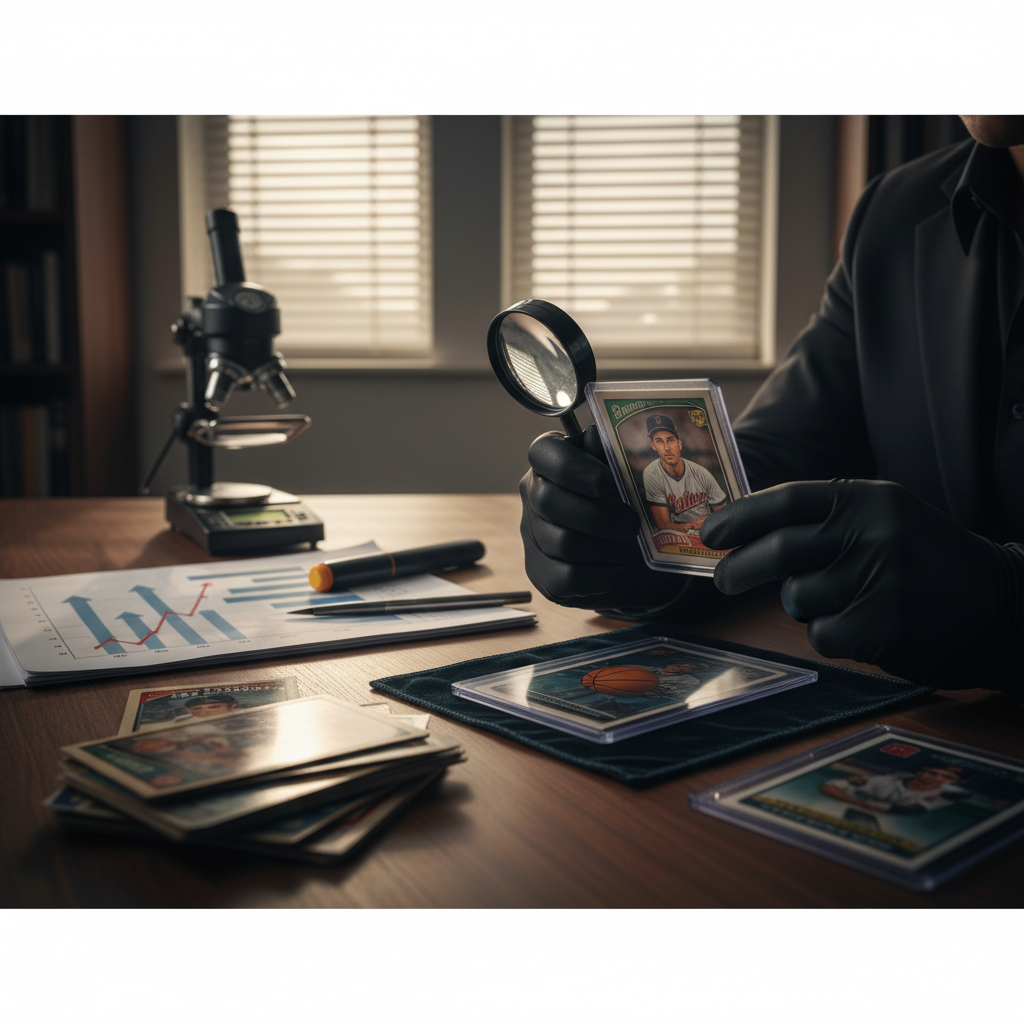
Arm yourself with knowledge. This is the 8-point inspection every serious investor must master. Get a jeweler's loupe (10-30x magnification) and a black light; they are the stethoscope and MRI of our industry.
1. The Loupe Test: Print Pattern & Pixels
This is the most critical test. Authentic cards have a distinct printing pattern for their era. Fakes almost always get this wrong.
- Real Cards: When viewed under a loupe, vintage cards (pre-1990) display a "Rosetta pattern"—a series of tiny dots in a circular or matrix formation that create the image. The colors are layered, and the dots are crisp and distinct.
- Fake Cards: Fakes are often produced with modern inkjet or laser printers. Under a loupe, you won't see a clean Rosetta pattern. Instead, you'll see fuzzy, bleeding colors, a chaotic spray of pixels, or sharp, uniform dots that are too perfect for the era.
Case Study: The 1986 Fleer Michael Jordan #57 Look at the red border on the front or the text in the stats box on the back. A real #57 has a clean, discernible dot pattern. Most fakes will show a blurry, pixelated mess, especially around sharp lines like the lettering of "Michael Jordan."
2. Card Stock: Feel, Flex, and Finish
How the card feels in your hand is a powerful, albeit subjective, indicator.
- Real Cards: Vintage stock has a specific raw, almost organic feel. It has a certain stiffness and produces a sharp "snap" when lightly flicked. Modern chrome cards have a specific weight and a mirror-like finish.
- Fake Cards: Fakes often use modern, cheap card stock that can be too glossy, too flimsy, or too white. A common mistake is using modern UV-coated stock to replicate a vintage card, which feels instantly wrong to an experienced hand.
3. Color Saturation & Photo Quality
Counterfeiters struggle to perfectly match the original color palette.
- Real Cards: Have known color tones. A 1952 Topps card has a muted, classic palette. An early-2000s refractor has a vibrant, dynamic rainbow sheen.
- Fake Cards: Colors are often over-saturated, making players look sunburned, or they are dull and washed out. The photo itself can be a dead giveaway—often scanned from a lower-resolution source, it will appear blurry or lack detail compared to a known authentic copy.
Case Study: The 2003 Topps Chrome LeBron James #111 The gold standard Refractor parallel of this card has a brilliant, almost liquid reflection. Fakes cannot replicate this. They often have a static, yellowish, or brownish tint that doesn't "refract" light correctly.
4. Logos, Fonts, & Text
Sloppy typography and fuzzy logos are a counterfeiter's calling card.
- Real Cards: Team logos, brand marks (Topps, Panini, Upper Deck), and the text on the card back are razor-sharp, even under magnification.
- Fake Cards: Look for blurry edges on logos. The ® (registered trademark) symbol is often a blurry blob on fakes, while it's a perfectly clear circle with a legible "R" on authentic cards. The font on the back may be slightly different—a bit thicker, a bit thinner, or spaced incorrectly.
5. The Black Light Test (UV Light)
This is a simple, devastatingly effective test, especially for vintage cards.
- Real Cards: Most paper stock made before the early 1990s does not contain modern artificial brightening agents. When exposed to a UV (black) light, it will not glow, or will glow only faintly.
- Fake Cards: If a counterfeiter prints a "1979 O-Pee-Chee Wayne Gretzky" on modern paper, it will glow intensely blue or white under a black light. This is an instant disqualification.
6. Holograms & Security Features
For cards from the 1990s onward, security features are your best friend.
- Real Cards: The Upper Deck hologram, the Topps "Chrome" stamp, the Panini Prizm etching—these are complex to produce. Study what a real one looks like; they have depth and detail.
- Fake Cards: Holograms on fakes are often flat, sticker-like, and lack the 3D depth of the real thing. They may be the wrong size or placed incorrectly on the card.
7. The Physical Cut & Edges
Factory cutting processes leave distinct marks.
- Real Cards: Edges should be crisp but consistent with the era. Some vintage sets are known for having rougher, "saw-cut" edges. Pre-war cards like the T206 set are notoriously uneven.
- Fake Cards: A card with unnaturally perfect, razor-sharp edges can be a red flag for a vintage issue. Conversely, a modern card with sloppy, hand-cut-looking edges is suspicious. Sometimes fakes are slightly larger or smaller than the standard 2.5" x 3.5" dimensions.
8. The Graded Slab Itself
As card values have exploded, so has the market for fake graded slabs. Counterfeiters place fake cards in fake holders.
- Real Slabs (PSA/BGS/SGC): Have specific characteristics. The plastic is high-quality and sonically welded, creating a "frosted" edge. The label has specific fonts, holographic security marks (on newer versions), and zero spelling errors.
- Fake Slabs: The plastic can feel cheap and flimsy. You might be able to feel seams or even pry it open. The label is the biggest giveaway: look for incorrect fonts, fuzzy printing, or a hologram that looks like simple foil. Actionable Step: ALWAYS use the grading company's website to verify the certification number on the label. If the number doesn't match the card in the holder, it's a fake.
The Economics of a Fake: ROI vs. Total Loss
Let's run the numbers. The math is unforgiving.
Scenario: The Raw Card Gamble You see a raw 2000 Bowman Chrome Tom Brady rookie that looks clean. The seller is asking $1,500, a discount from the $2,500 market rate for a potential PSA 8. You believe it could grade a PSA 9, worth over $5,000.
- Potential ROI: ($5,000 value - $1,500 cost - $150 grading fee) / $1,650 cost = 203% ROI.
- The Reality: You submit the card to PSA. It comes back as "Questionable Authenticity." The card is worthless. Your realized ROI is -100%. Your total loss is $1,650.
This is why HobbyAlpha's Card Advisor tool is so crucial. Before you spend a dime, you can assess the risk profile of such a purchase against its potential reward.
Your Defensive Playbook: A 4-Step Verification Process
Source the Seller, Not Just the Card: Buy from reputable dealers or consignment platforms like PWCC and Goldin that have robust authentication processes. Scrutinize feedback on peer-to-peer sites. A brand new seller with a high-dollar card is a major red flag.
Compare to Known Authentics: Do not use Google Images. Use the PSA and SGC certification lookup tools, which often have high-resolution scans of the exact card. Heritage Auctions and Goldin also have vast archives of high-res images from past sales. Compare every detail.
Trust, But Verify with Tools: Even if a card looks good, perform the checks. Use your loupe. Use your black light. Weigh the card on a gram scale if you have data on its expected weight. Data trumps gut feelings.
When in Doubt, Buy Graded: For high-value cards, buying graded is the single best way to mitigate risk. And when you do, verify the cert number on the grading company's website before your payment becomes final. Track real-time comps using HobbyAlpha's Daily Alpha to ensure you're not overpaying for a legitimate, but overpriced, card.
Conclusion: Your Portfolio's Best Defense
Spotting fakes isn't about paranoia; it's about portfolio management. Every dollar you lose on a fake is a dollar you can't allocate to a genuine asset with real growth potential, like those surfaced by our Hidden Gems tool. The counterfeiter's goal is to exploit emotion and the fear of missing out. Your defense is to be dispassionate, methodical, and data-driven.
By mastering the techniques in this guide—the loupe test, UV light analysis, source verification, and leveraging data tools—you move from being a potential victim to being a savvy, protected investor. In the world of sports card investing, the best offense is a great defense.
Frequently Asked Questions
What is the single best tool for spotting fake sports cards?
A 10x-30x jeweler's loupe is the most critical tool. It allows you to examine the card's printing pattern, which is the most difficult element for counterfeiters to replicate correctly. Seeing a blurry, pixelated image instead of a crisp, era-appropriate dot pattern is the #1 sign of a fake.
Are fake cards only a problem for expensive vintage cards?
No. While iconic vintage cards are prime targets, high-value modern cards, especially key rookie refractors and parallels (like Patrick Mahomes or Luka Dončić), are heavily counterfeited. The high market value of these cards makes them profitable targets for scammers.
How reliable are the QR codes on new graded card slabs?
The QR codes on new slabs from PSA, BGS, and SGC are reliable and a great first step. However, for maximum security, you should always manually type the certification number into the grading company's official database to confirm the code hasn't been faked or cloned.
What should I do if I accidentally buy a fake card?
Act immediately. If you purchased on a platform like eBay, initiate a return request under the 'not as described' or 'counterfeit item' policy. If you paid with a credit card, file a chargeback. Document all your evidence (photos, comparisons) and contact the seller directly. The sooner you act, the better your chances of a full refund.
Is it illegal to knowingly sell a counterfeit sports card?
Yes. Knowingly selling a counterfeit item as authentic is a form of fraud and is illegal. It violates federal and state laws regarding intellectual property, trademark infringement, and mail/wire fraud if the transaction is done online or shipped.
How does a card's population report help spot fakes?
The population report on a grading company's website tells you how many of a certain card exist in each grade. This is useful for spotting fake slabs. If a seller offers a card with a certification number that the database shows belongs to a different card, or if the graded population seems impossibly high, it's a major red flag.