NBA vs. NFL vs. MLB: A Data-Driven Guide to Card Market Dominance
'''
NBA vs. NFL vs. MLB: A Data-Driven Guide to Card Market Dominance
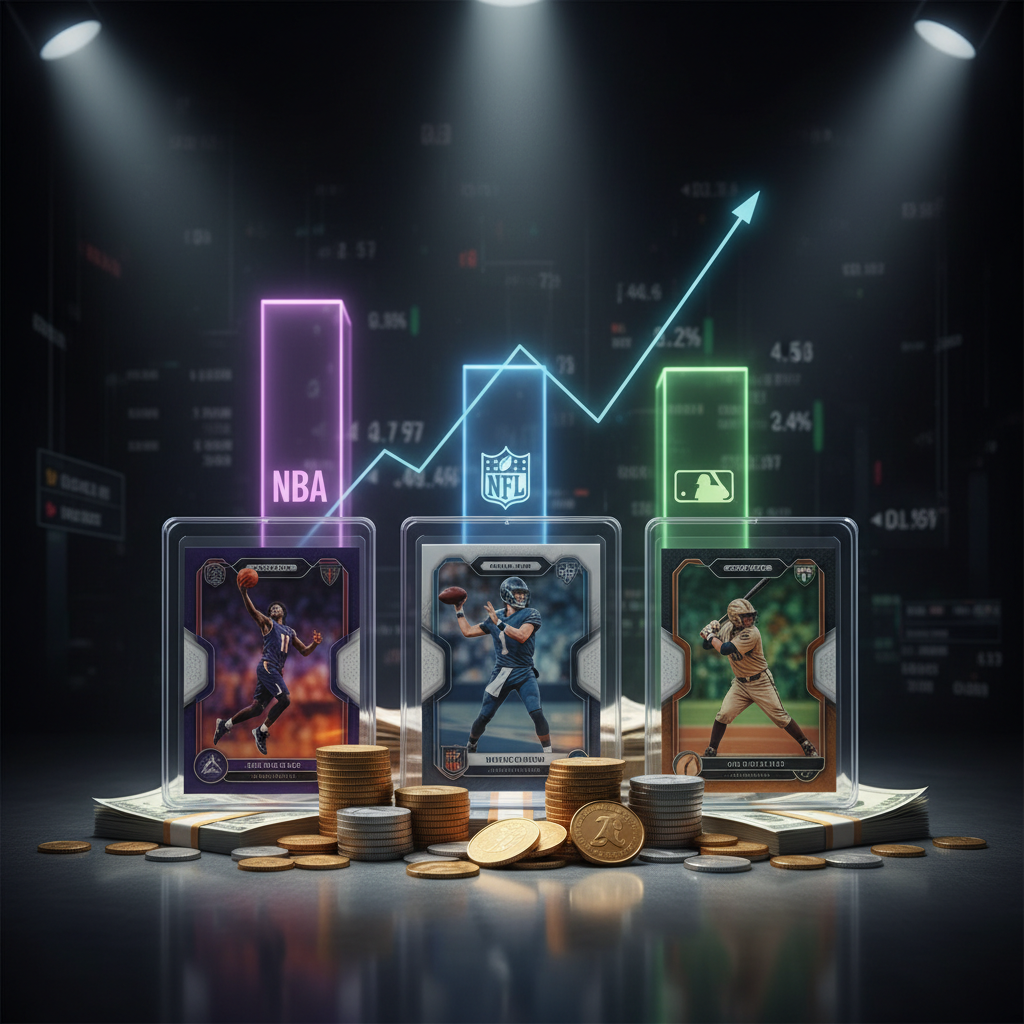
The debate is as old as the schoolyard: Jordan vs. Montana vs. Mantle. But for the serious investor in 2024, the question isn't about who is the GOAT athlete, but which of their markets is the GOAT asset class. Where should you allocate your capital for the optimal blend of growth, stability, and liquidity? Is the NBA's high-flying global growth a better bet than the NFL's unshakeable domestic dominance or MLB's century of tradition?
This is not a matter of opinion. It’s a matter of data. As analysts at HobbyAlpha, we dissect these markets daily. The answer isn’t about picking the "best" sport; it's about understanding the unique economic engine of each league's card market and aligning it with your investment strategy. This definitive guide will break down the data, the core assets, and the ROI math to declare a winner for every type of investor.
The Core Metrics: How We Define a "Strong" Market
Before comparing the leagues, we must define our terms. A "strong" market isn't just about high prices. It's a combination of factors that create a healthy, investable ecosystem. We measure market strength across these five KPIs:
- Market Size & Total Sales Volume: The total capital flowing through a market. Higher volume means greater liquidity and more stable price discovery.
- High-End "Grail" Sales: The market's ceiling. A multi-million dollar sale for a single card (a '52 Mantle, a Brady Auto) sends a powerful signal of confidence to the entire ecosystem.
- Prospecting Velocity: The speed and intensity at which new players generate market heat. This is a key indicator of a market's dynamism and potential for explosive growth.
- Global Reach: The degree to which a market transcends domestic borders. A global collector base provides a wider funnel of demand and a hedge against regional economic downturns.
- Blue-Chip Stability: The ability of a market's top assets to hold value over time, behaving like traditional blue-chip stocks. This is the foundation of long-term investing.
The NBA Market: High-Octane Growth and Global Appeal
The NBA card market is the growth story of the modern hobby. It is volatile, momentum-driven, and possesses a global appeal that the other two major American sports cannot match. It is, in investment terms, a high-beta growth stock.
The Player-Centric Universe
More than any other sport, the NBA is driven by individual superstars. A single player can elevate the entire market. The hobby saw this with Michael Jordan, whose 1986 Fleer #57 rookie card in a PSA 10 is a primary market benchmark. We saw it again with LeBron James, and we are witnessing it in real-time with Victor Wembanyama.
This player-centricity creates immense opportunities for explosive gains. The market's focus on a handful of "faces of the league" concentrates demand, causing prices for their key cards to skyrocket with a speed unheard of in other sports.
Case Study: Prospecting Fever (Zion vs. Wemby)
The 2019-20 season, fueled by Zion Williamson's debut, saw the modern card market explode. His 2019 Panini Prizm Silver rookie cards were trading for thousands of dollars before he played a full season. This mania demonstrated the NBA market's appetite for speculation. However, it also showed the risk; as Zion's career has been hampered by injuries, those same cards have fallen over 80% from their peak.
Fast forward to Victor Wembanyama. The hype is even greater, but now it's on a global scale. His 2023 Panini Prizm cards are the undisputed chase of the entire hobby, demonstrating the league's power to create a singular, must-have asset.
NBA Grading Economics: The GEM Mint Premium
The profitability in modern NBA cards is brutally tied to the PSA 10 (Gem Mint) grade. The premium is massive, creating a high-risk, high-reward proposition.
- Raw Card: 2023 Prizm Silver Victor Wembanyama - ~$450
- Grading Fee (PSA Regular Service): ~$75
- Total Investment: ~$525
- Value if PSA 10: ~$2,200 (a 320% ROI)
- Value if PSA 9: ~$600 (a 14% ROI)
Analysis: The math is clear. A PSA 10 grade delivers a home run, but a PSA 9 barely covers your cost and time. The NBA market punishes anything less than perfection on its key modern cards. For real-time price tracking on assets like this, savvy investors use HobbyAlpha's Market Outlook tool to see if the trend is their friend.
Verdict: The NBA is the strongest market for investors seeking maximum growth potential who are comfortable with significant volatility. Its unparalleled global reach provides a long-term tailwind that the other leagues lack.
The NFL Market: The Unshakeable Juggernaut
If the NBA is a tech growth stock, the NFL is a blue-chip index fund. It is the largest, most liquid, and most stable of the three markets. Its strength is built on the bedrock of the largest domestic fanbase in American sports and the singular importance of one position: the quarterback.
The Quarterback is King
The NFL market is a quarterback market. While other positions have their collectors, roughly 80% of the market's value and volume is concentrated in QBs. This simplifies the investment thesis: identify and acquire the key rookie cards of elite quarterbacks.
Case Study: Brady, the Bedrock vs. Mahomes, the New Blue-Chip
The anchor of the entire NFL market is Tom Brady. His 2000 Playoff Contenders Championship Ticket Autograph card is the "Mantle of football." A BGS 9 sold for $2.4 million in 2022. The stability of Brady's key rookie cards provides a high-confidence store of value for the whole market.
Patrick Mahomes represents the new guard. His 2017 Panini Prizm and National Treasures Rookie Patch Autographs (RPAs) have been the primary drivers of market growth over the last five years. Tracking the price appreciation of a 2017 Prizm hobby box—which HobbyAlpha's Sealed Product ROI Calculator shows has increased over 2,000% since release—is a direct proxy for the "Mahomes effect."
NFL Grading Economics: A More Forgiving Model
Compared to the NBA, the economics of grading mid-tier NFL rookie cards are more forgiving, making it a more accessible market.
- Raw Card: 2020 Panini Prizm Silver Joe Burrow #307 - ~$150
- Grading Fee (PSA Value Service): ~$40
- Total Investment: ~$190
- Value if PSA 10: ~$400 (a 110% ROI)
- Value if PSA 9: ~$200 (a 5% ROI)
Analysis: The GEM premium is still strong, but a PSA 9 doesn't result in a loss. This allows for a more volume-based approach to grading, where an investor can process multiple key rookie QBs and profit from the average return rather than relying on a single grand slam.
Verdict: The NFL is the strongest market for investors who prioritize stability, liquidity, and a "blue-chip" strategy. Its focus on quarterbacks creates a clear and actionable investment path with a proven track record of steady, long-term growth.
The MLB Market: History, Tradition, and Complexity
The MLB card market is the original and, in many ways, the most complex. It's fundamentally bifurcated into two distinct ecosystems: the ironclad vintage market (pre-1980) and the highly speculative modern prospecting market.
The Vintage Bedrock: A True Store of Value
The vintage baseball card market behaves more like the fine art market than a modern sports memorabilia market. Cards like the 1952 Topps Mickey Mantle #311 (a PSA 9 sold for $12.6 million in 2022) are globally recognized alternative assets. They are a pure store of value, insulated from player performance and driven by scarcity, condition, and historical significance. For a portfolio cornerstone, nothing in sports cards is more stable than high-grade vintage baseball.
Prospecting: The "Path to the Show"
Modern baseball investing is the ultimate high-risk, high-reward scouting mission. Unlike the NBA or NFL, where top draft picks are immediate market drivers, baseball prospects can spend 3-5 years in the minor leagues. The key asset is not the Topps flagship rookie card, but the "1st Bowman" card, specifically the Bowman Chrome Autograph, which is a player's first licensed autograph card, often released years before their MLB debut.
Hitting on a top prospect early—like buying Mike Trout's 2009 Bowman Chrome Auto before his ascent—can yield returns of over 10,000%. However, the bust rate for prospects is extraordinarily high. For every Mike Trout, there are a hundred "can't-miss" kids who never pan out. This is where a tool like HobbyAlpha's Hidden Gems becomes invaluable, analyzing minor league performance data against early market prices to spot undervalued opportunities.
MLB Grading Economics: The Bowman Auto Bet
Let's look at a top prospect's key card, where the autograph grade also comes into play.
- Raw Card: 2023 Bowman Chrome Draft Jackson Chourio Auto (Base Refractor) - ~$500
- Grading Fee (PSA Regular): ~$75
- Total Investment: ~$575
- Value if PSA 10: ~$1,100 (a 91% ROI)
- Value if PSA 9: ~$650 (a 13% ROI)
Analysis: The dynamic is similar to the NFL—a PSA 10 provides a strong return, while a 9 keeps you in the game. The added variable for many baseball cards is the autograph grade, which adds another layer of complexity and potential value.
Verdict: The MLB market is strongest for two distinct investor profiles. The first is the conservative, long-term investor focused on the stability of the vintage market. The second is the expert scout willing to do deep research for the home-run potential of Bowman prospecting.
The Final Verdict: An Asset Allocation Approach
So, which market is the strongest? The data shows there is no single winner. The strongest strategy is a diversified portfolio that leverages the unique strengths of each league.
| League | Primary Strength | Primary Risk | Investor Profile |
|---|---|---|---|
| NBA | Explosive Growth / Global Reach | High Volatility | Growth / Speculator |
| NFL | Stability / Liquidity | Domestically Focused | Blue-Chip / Balanced |
| MLB | Store of Value (Vintage) | Prospecting Complexity / Bust Rate | Traditionalist / Expert Scout |
We recommend a "HobbyAlpha Core Portfolio" allocation for a balanced approach:
- 40% NFL: Form the stable core of your portfolio with blue-chip quarterback rookie cards (Brady, Mahomes, Burrow, Stroud) and key sealed wax (Prizm, National Treasures). This provides liquidity and a steady growth floor.
- 35% NBA: Allocate for high growth, focusing on top-tier rookies (Wembanyama, Edwards) and proven young veterans. Use this segment of the portfolio to chase higher returns, balanced by the stability of your NFL holdings.
- 25% MLB: Divide this allocation. Use a portion to acquire a cornerstone vintage card (e.g., a high-grade Hank Aaron or Willie Mays rookie) as a long-term store of value. Use the remainder for a small, high-risk/high-reward portfolio of Bowman 1st Chrome Autos of prospects you have researched thoroughly.
To get personalized suggestions based on your exact budget and risk tolerance, you can use HobbyAlpha's Card Advisor tool.
Conclusion: Know Your Game
Ultimately, the strongest market is the one you understand best. The NBA offers thrilling, unparalleled growth. The NFL provides stable, predictable returns. And MLB offers a blend of historical significance and high-stakes prospecting.
The data reveals clear patterns and advantages for each. The savviest investors don't choose a league; they build a diversified portfolio that captures the best attributes of all three. The biggest returns go to those who dive deepest, do the research, and construct a portfolio that plays to their strengths. Now, go build yours. '''
Frequently Asked Questions
Which sports card market has the highest ROI?
The NBA market generally offers the highest potential for short-term ROI, especially with top rookies, but it also carries the highest volatility and risk. The NFL market provides more stable, predictable long-term ROI, while the MLB prospecting market has the highest 'home run' potential but a very high bust rate.
Are pitcher cards a bad investment in baseball?
Generally, pitcher cards are considered riskier investments than position players. Their careers are often shorter and more susceptible to single, devastating injuries. As a result, the market historically favors elite hitters, who tend to have better career longevity and a more sustained period of collectibility.
Should I invest in raw or graded sports cards?
This depends on your strategy. Buying graded cards offers known condition and instant liquidity, but at a premium price. Buying raw cards offers a lower entry point and the potential for a high ROI if they receive a high grade (like a PSA 10). However, this 'grading arbitrage' carries the risk that the card will receive a lower-than-expected grade, potentially resulting in a loss.
What is the single most important 'must-have' rookie card from each sport for a new investor?
For the NBA, the 2003 Topps Chrome #111 LeBron James is a modern icon. For the NFL, a base rookie card of a top modern QB like the 2000 Bowman Tom Brady #236 or 2017 Panini Prizm Patrick Mahomes II #269 is essential. For MLB, the 2011 Topps Update Mike Trout #US175 is the modern equivalent of a Mickey Mantle rookie.
How does the soccer card market compare to these three American sports?
The global soccer card market is massive and growing rapidly in the U.S. It shares many dynamics with the NBA market: it's highly player-centric (Messi, Ronaldo, Mbappé), has immense global appeal, and sees explosive growth around events like the World Cup. It is quickly becoming a 'fourth major' for American sports card investors.
What is the difference between a '1st Bowman' and a 'Topps Rookie Card'?
A player's '1st Bowman' logo card is their first appearance on a licensed card, typically in a Bowman product, while they are still a minor league prospect. The Topps 'Rookie Card' (RC) logo is applied to cards in flagship sets like Topps Series 1 after a player has made their official MLB debut. The 1st Bowman is the key card for prospecting; the Topps RC is the traditional rookie card for established major leaguers.